Active aging & sports: keep playing
Cross-Country Skiing and Shoulders: The Poling Motion
4-minute read · Published November 4, 2024 · Updated November 4, 2024
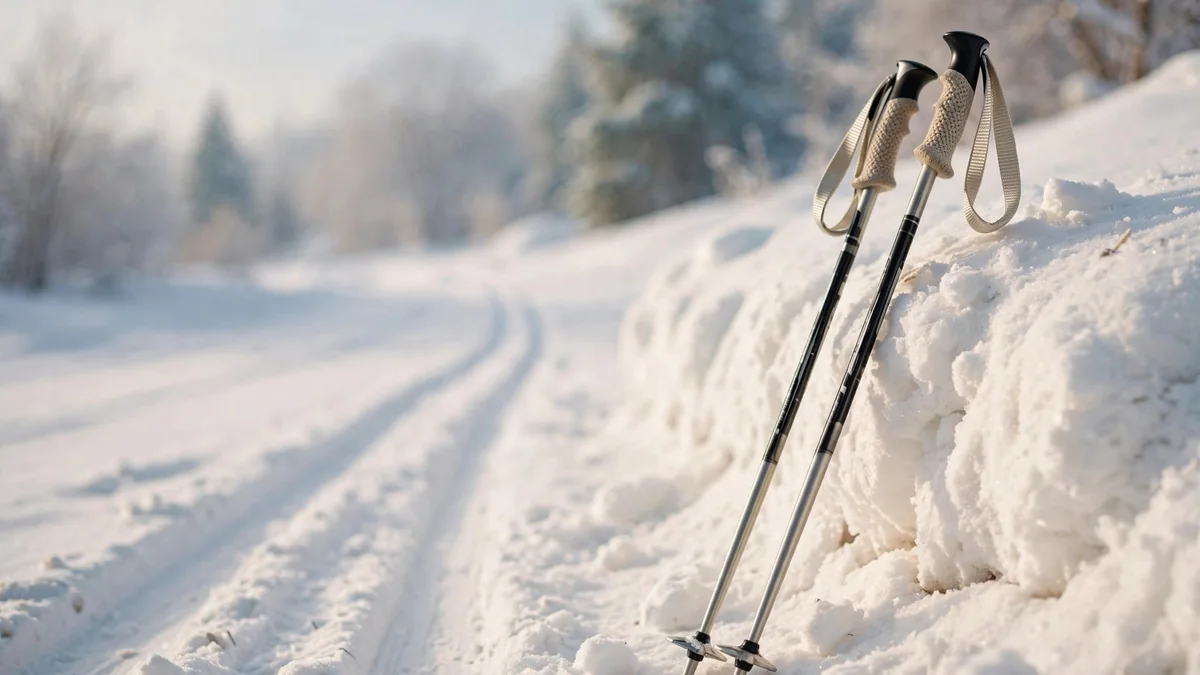
This post is part of our guide to shoulder exercises for active players. Two related reads are hiking with trekking poles and kayaking and canoeing prep.
What the poling motion asks of your shoulder
Each stride, you plant a pole and push. Your arm reaches forward and across, then pushes back as your trunk rotates. Repeat that for an hour, and the shoulder does a lot of work. Uphill and in deep snow, the load increases.
The motion is both a push and a pull. It uses the shoulder blade, the rotator cuff and the large muscles of the back and chest. When any of these is weak, or the endurance is not there, the arm can start to feel it near the end of a long day.
What the research says
- The WHO recommends 150 to 300 minutes of moderate activity a week for adults, plus muscle-strengthening activity on at least two days. It also says every move counts [R07]. Skiing can count toward the activity goal, and strength work covers the other part.
- Resisted exercise that gets a little harder over the weeks probably helps shoulder pain, while gentle unloaded movement alone probably does not [R01]. This is about the rotator cuff in general, not skiing.
- Two-arm training has been studied in stroke rehabilitation. It improved shoulder movement more than single-arm training there. That evidence is from stroke patients, so it suggests an idea rather than proving anything for skiers [R14].
What you can do
Build up before the season, then keep a steady routine. Each step has a seated option.
- Seated poling. Sit tall and hold a light object in each hand, such as a water bottle. Reach forward with one arm and pull back with the other, alternating. Ten reps each side.
- Seated diagonal reach. Reach one hand toward the opposite hip and back up, keeping the movement smooth. Eight reps each side.
- Strength two or three days a week. Include light pulling and pushing work. Increase only when the previous level feels easy.
- Warm up before you ski. Spend five minutes on gentle arm circles and reaches before the first run.
- Watch the next morning. A mild ache that settles within a day is normal. Sharp pain or pain that lingers means you should back off and get advice.
Where ShoulderBack Pro fits, and where it doesn't
Crosscuts is the best match for poling. It is a diagonal glide from a high shoulder to the opposite hip, designed to work the lats, obliques and scapular retractors that drive the reach and pull. Boxing, a soft alternating push, suits the pole plant. Because the resistance comes from your other arm, you progress by resisting harder, moving through more range or doing longer sets.
It is a wellness tool, not a treatment, and there are no clinical trials of it, so pair it with walking and general strength work. ShoulderBack Pro is $29 CAD and you can order it online.
When to see a professional
See a doctor or physiotherapist promptly if you have: pain after a fall or injury with sudden weakness or loss of movement; a shoulder that looks deformed, very swollen or bruised; fever or feeling unwell alongside the pain; chest pain or breathlessness (call emergency services); constant pain that doesn't change with rest or activity; pain that wakes you most nights; numbness, tingling or weakness into the arm or hand; pain in several joints at once; or pain that hasn't improved after a couple of weeks of sensible self-care.
A fall on the snow with sudden weakness or deformity needs prompt assessment. A doctor or physiotherapist is the person who diagnoses the cause of ongoing pain.
Try this movement
Crosscuts (lats, obliques, scapular retractors) →Frequently asked questions
Is poling bad for my shoulders?
Not in itself. Repeated poling is a normal part of skiing for many people. Problems are more likely when strength, technique or training volume do not match the demand.
How do I prepare before the season?
Start several weeks before the first ski. Build general strength two or three days a week and add some controlled movement. Increase gradually.
What if my shoulder hurts after skiing?
Rest and gentle movement are usually sensible for a day or two. If pain lasts beyond a couple of weeks, or wakes you at night, see a doctor or physiotherapist.
Sources
- Naunton J et al. (2020). Effectiveness of progressive and resisted and non-progressive or non-resisted exercise in rotator cuff related shoulder pain: systematic review and meta-analysis of RCTs. Clinical Rehabilitation. https://search.pedro.org.au/search-results/record-detail/61404
- WHO (2020). Guidelines on physical activity and sedentary behaviour. https://www.sydney.edu.au/news-opinion/news/2020/11/26/new-global-guidelines-on-physical-activity-and-sedentary-behavio.html
- Journal of Physical Therapy Science (2016). The effects of bilateral movement training on upper limb function in chronic stroke patients. https://pmc.ncbi.nlm.nih.gov/articles/PMC5011582