Active aging & sports: keep playing
Hiking With Trekking Poles: Shoulders, Arms and the Downhill
4-minute read · Published April 9, 2025 · Updated April 9, 2025
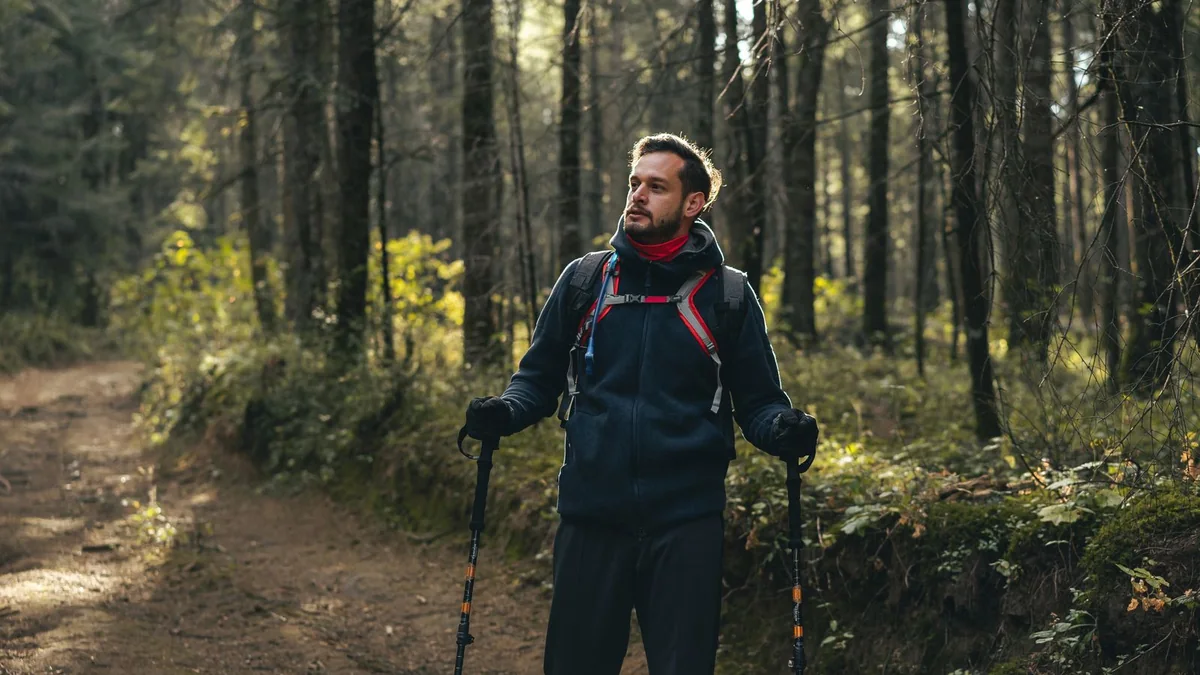
What this is
Each time you plant a pole, your arm takes weight and your shoulder works to keep the joint steady. Over a long hike, that adds up. On climbs you pull and push. On descents, the poles catch part of your body weight, and the shoulder absorbs the jolt.
The wrist strap matters. Used well, it carries the load so your grip can stay relaxed. Used badly, it can make you clench the handle and tense the forearm and shoulder.
What the research says
Our sources do not study trekking poles directly, so read the advice below as practical reasoning, not proof (evidence varies, ask your clinician).
For shoulder pain in general, exercise that works the shoulder blade and rotator cuff can improve pain and function. One review found that scapular stabilization exercise improved pain and function [R03]. For older adults, resistance training supports function and independence. Its position statement says barriers and fears should be addressed, which matters if a hike feels daunting [R06]. National guidance says adults should do muscle-strengthening work at least two days a week [R07].
What you can do
- Set the height before you start. Adjust the poles so your elbow sits comfortably bent, not stretched.
- Use the straps properly. Slide your hand up through the strap and let the strap take the load, so your grip stays relaxed.
- Keep the elbows soft on descents. Do not lock your arms straight when you plant the pole.
- Warm up seated. Before the hike, sit tall and slowly sweep your arms up and out, then down again, within a comfortable range.
Where ShoulderBack Pro fits — and where it doesn't
For off-trail control work, Crosscuts is a sensible match. One hand glides diagonally from the high shoulder toward the opposite hip while the other arm resists, which works the lats, the obliques and the muscles that draw the shoulder blade back. That diagonal rhythm resembles walking with poles, though it is a likeness of movement, not proof it helps hikers. To progress, resist harder with the other arm, move through a little more range, or do longer sets. Do it seated or standing, with no anchors or weights. It is one of the 16 video lessons.
It is a wellness tool with no clinical trials behind it, so it is not a treatment for any condition. Details on the trainer are on the shop page.
When to see a professional
See a doctor or physiotherapist promptly if you have: pain after a fall or injury with sudden weakness or loss of movement; a shoulder that looks deformed, very swollen or bruised; fever or feeling unwell alongside the pain; chest pain or breathlessness (call emergency services); constant pain that doesn't change with rest or activity; pain that wakes you most nights; numbness, tingling or weakness into the arm or hand; pain in several joints at once; or pain that hasn't improved after a couple of weeks of sensible self-care.
Try this movement
Crosscuts (lats, obliques, scapular retractors) →Frequently asked questions
Do trekking poles cause shoulder pain?
Not by themselves for most people. Discomfort is more likely when hikers lean hard, lock their elbows or carry load through the arms for hours. Evidence on poles specifically is limited, so ask your clinician if pain persists.
Should I use poles on the downhill?
Many hikers find poles helpful going down, because they share the impact. Keep your elbows soft and avoid bracing hard on the poles.
What if I hike with a sore shoulder?
Shorten the hike, use the poles for support only, and stop if pain sharpens, wakes you at night, or comes with numbness or weakness.
Sources
- Frontiers in Bioengineering & Biotechnology (2025). Specific modes of exercise to improve rotator cuff-related shoulder pain: systematic review and meta-analysis. PROSPERO CRD42024550602. https://pmc.ncbi.nlm.nih.gov/articles/PMC12011739/
- Fragala MS, Cadore EL, Dorgo S et al. (2019). Resistance Training for Older Adults: Position Statement From the National Strength and Conditioning Association. J Strength Cond Res. https://pubmed.ncbi.nlm.nih.gov/31343601/
- WHO (2020). Guidelines on physical activity and sedentary behaviour. https://www.sydney.edu.au/news-opinion/news/2020/11/26/new-global-guidelines-on-physical-activity-and-sedentary-behavio.html