Younger adults: desks, screens, lifting, parenting, travel
Carrying a Toddler on One Hip: Why One Shoulder Takes the Hit
4-minute read · Published June 11, 2025 · Updated June 11, 2025

Why this happens
Your toddler sits on one hip, so the arm on that side keeps lifting and holding them. The shoulder on that side likely works harder to steady the arm, while the other side often does less. Toddlers also wriggle, so small corrections add up through the day. Only a clinician can tell what is behind your pain.
What the research says
Research on parents who carry toddlers is thin, so treat this as general shoulder evidence. [R03] reviewed specific exercise types for rotator cuff-related shoulder pain in 2025 and found that scapular stabilization exercise (training the muscles that steady the shoulder blade) improved pain and function.
[R01] found that resisted exercise which progresses over time probably helps shoulder pain. Gentle, unloaded movement alone probably does not move the needle on pain.
What you can do
- Switch hips on purpose. Alternate sides through the day.
- Share the load. Hand the toddler off, or set them down for short breaks.
- Shorten the carries. Or ask a partner to take a turn.
- Do a seated reset. Sit in an armchair with your back supported. Let the arm hang, then roll the shoulder slowly, about ten times each way. Stop if you feel sharp pain.
- Balance the week. Add a few minutes of gentle two-arm movement on both sides most days.
Where ShoulderBack Pro fits, and where it doesn't
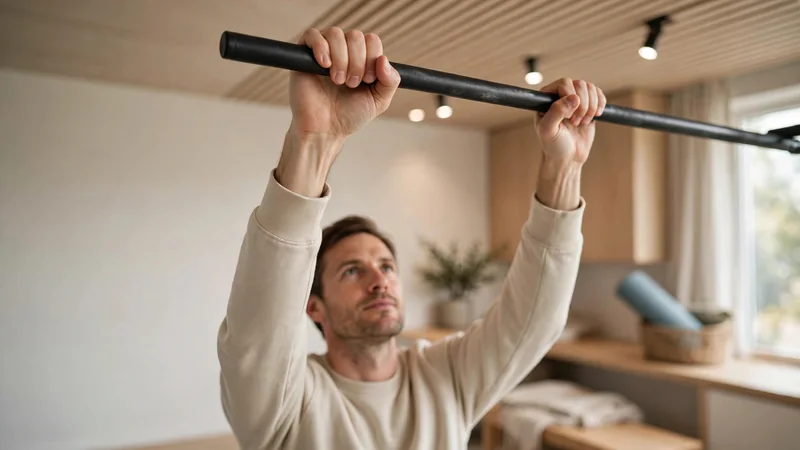
For evening balance work, Steering is a good match: you turn an imaginary wheel at ten-and-two, designed to work the deltoids and rhomboids on both sides evenly, with one arm resisting the other. You can do it in an armchair. Try the Steering lesson, and the trainer is on the shop page if it suits you.
It will not change how you carry your toddler, and it is a wellness tool, not a treatment for a diagnosed condition.
See a doctor or physiotherapist promptly if you have: pain after a fall or injury with sudden weakness or loss of movement; a shoulder that looks deformed, very swollen or bruised; fever or feeling unwell alongside the pain; chest pain or breathlessness (call emergency services); constant pain that doesn't change with rest or activity; pain that wakes you most nights; numbness, tingling or weakness into the arm or hand; pain in several joints at once; or pain that hasn't improved after a couple of weeks of sensible self-care.
When to see a professional
Get assessed before carrying on as usual if the pain follows a fall, a sudden strain, or a loss of movement. A doctor or physiotherapist diagnoses shoulder problems.
Learn more
Try this movement
Steering (deltoids, rhomboids) →Frequently asked questions
Is it normal for one shoulder to ache after carrying a toddler?
Mild tiredness after a long day is common. Pain that lingers, wakes you at night, or comes with numbness needs a clinician.
Can a carrier take some of the load off?
Many parents find a well-fitted carrier spreads weight across the body. Ask a clinician which carry suits a sore shoulder.
Does exercise help this kind of ache?
Some evidence suggests resisted exercise that progresses over time probably helps shoulder pain [R01]. Ask your clinician what fits you.
Sources
- Naunton J et al. (2020). Effectiveness of progressive and resisted and non-progressive or non-resisted exercise in rotator cuff related shoulder pain: systematic review and meta-analysis of RCTs. Clinical Rehabilitation. https://search.pedro.org.au/search-results/record-detail/61404
- Frontiers in Bioengineering & Biotechnology (2025). Specific modes of exercise to improve rotator cuff-related shoulder pain: systematic review and meta-analysis. https://pmc.ncbi.nlm.nih.gov/articles/PMC12011739/