Active aging & sports: keep playing
Balance, Falls and Upper-Body Strength: The Link Most People Miss
6-minute read · Published November 25, 2026 · Updated November 25, 2026
Why this happens
When you start to lose your footing, your body reaches for something. Your arms swing out, your shoulders lift, and your upper body tries to pull you back over your feet. Strong shoulders and a responsive upper back make that reach more effective. They do not replace the reflexes in your legs and feet, or the sense of where your body is in space.
That sense is called proprioception, or joint position sense. Shoulder problems are linked with reduced proprioception, which can affect how accurately you move [R16]. Balance depends on many systems working together, so a plan that trains only one part of the picture leaves gaps.
What the research says
The World Health Organization asks adults aged 65 and older to do multicomponent activity that emphasises functional balance and strength, at least three days a week [R07]. Balance and strength are named together on purpose.
Resistance training is one of the best-supported ways to keep older adults strong and independent. A position statement from the National Strength and Conditioning Association describes resistance training as countering muscle loss and supporting function, mobility, independence and quality of life. It also says that barriers and fears should be addressed [R06].
Muscle loss is a real concern as we age. Sarcopenia, the progressive loss of muscle, affects almost one in three older people. Resistance exercise is the first-line approach, because no drug exists to replace it [R08].
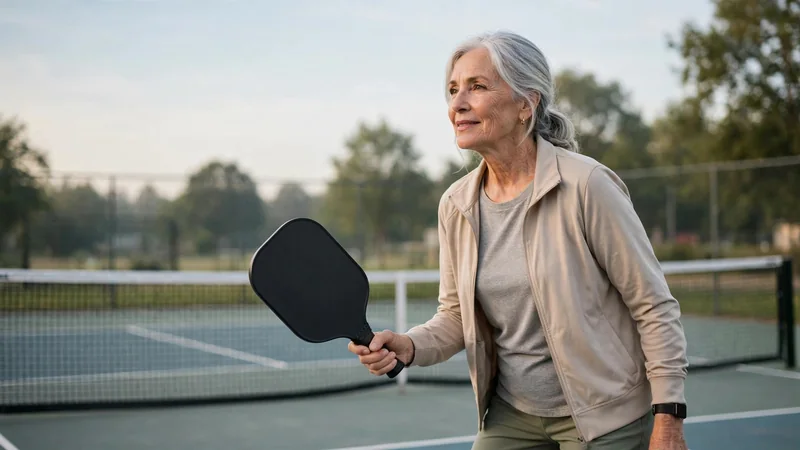
Falls matter for the shoulder too. In a 10-year study of pickleball injuries, falls were the most common way people were hurt, and sprains, strains and fractures were the most common injuries [R32]. In a study of players aged 60 and older, strains and sprains made up about a third of injuries and fractures about 28 percent [R33]. The numbers come from pickleball players, but the lesson applies more widely: a fall can injure the shoulder and the hip at the same time.
What you can do
- Get a fall-risk check. Ask your family doctor or a physiotherapist to assess your balance and walking. This is especially important after any fall, even a small one.
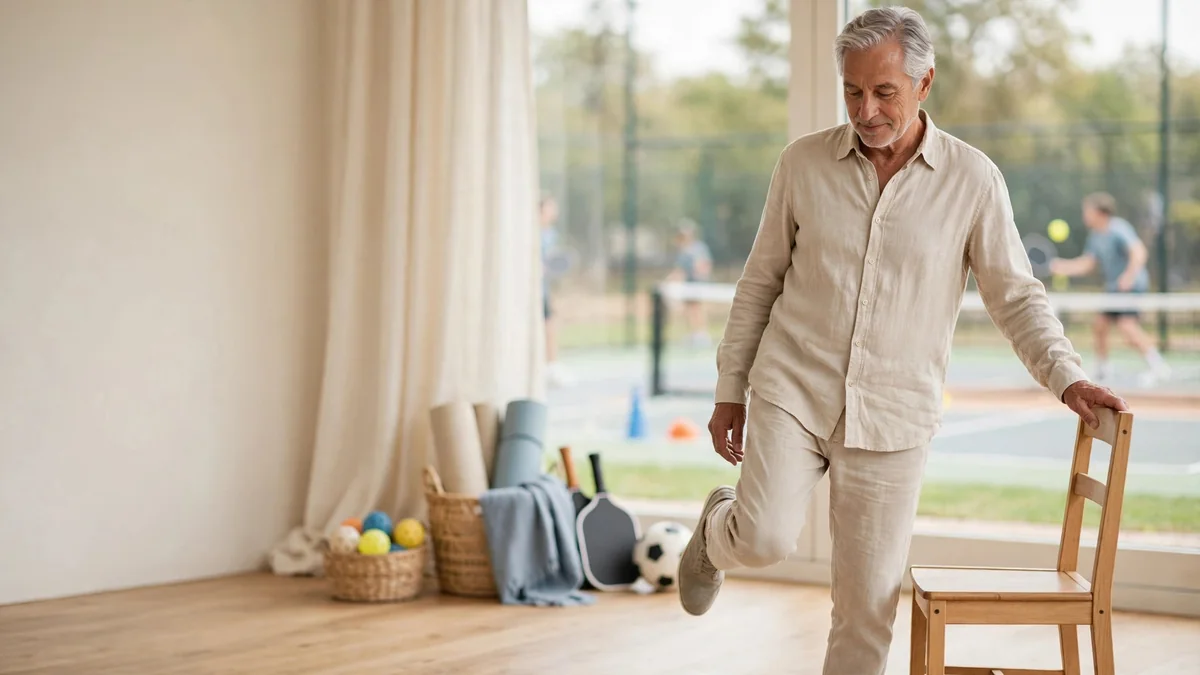
- Add balance practice to your week. Ask a physiotherapist which exercises suit you. Holding onto a sturdy counter while you shift weight is a common starting point.
- Train your legs. Seated leg extensions and sit-to-stand practice build the strength you use to get up and steady yourself.
- Train your upper body in a controlled way. Seated arm movements, slow reaches and gentle rows with a band or light weight all count. Keep the range pain-free.
- Practise recovering your balance safely. Stand near a counter or a wall. Shift your weight slowly and step with control. Never practise alone if you feel unsteady.
- Review your home. Clear loose rugs, add light at night, and keep often-used items within easy reach.
Keep sessions short and repeat them most days. Steady progress over several weeks is more useful than a single hard session.
Where ShoulderBack Pro fits, and where it doesn't
The one part of this plan a tool like ShoulderBack Pro can touch is upper-body control. The Crosscuts movement, a diagonal glide from high shoulder to opposite hip, is designed to work the lats, obliques and the muscles that draw the shoulder blades back. One arm resists the other, so you set the effort, and you can do it seated. It is a wellness tool with no clinical trials behind it, so it is not a treatment for any condition. It does nothing for your legs or balance, so a clinician's plan comes first. See the shop page if you want details.
See a doctor or physiotherapist promptly if you have: pain after a fall or injury with sudden weakness or loss of movement; a shoulder that looks deformed, very swollen or bruised; fever or feeling unwell alongside the pain; chest pain or breathlessness (call emergency services); constant pain that doesn't change with rest or activity; pain that wakes you most nights; numbness, tingling or weakness into the arm or hand; pain in several joints at once; or pain that hasn't improved after a couple of weeks of sensible self-care.
When to see a professional
If you have fallen, or your shoulder hurts after a fall, get it checked the same day. A clinician needs to rule out a fracture or other injury first. A doctor or physiotherapist can also assess your balance and fall risk, which is the best way to decide what you need. Only a clinician can diagnose the cause of a balance problem or shoulder pain.
Related reading: Shoulder exercises for pickleball players: strength, control and endurance, Muscle loss after 50: what sarcopenia is and why resistance beats everything and Why falls, not serves, cause most pickleball injuries.
Try this movement
Crosscuts (lats, obliques, scapular retractors) →Frequently asked questions
Does upper-body strength prevent falls?
Not on its own. Balance and leg strength matter a great deal. Upper-body strength can still help you steady yourself and recover when you are off balance.
What is the best exercise for balance?
Guidance for older adults asks for functional balance work alongside strength. Ask a physiotherapist which balance exercises suit you, especially if you have already fallen.
Can ShoulderBack Pro help me avoid falls?
It is not designed as a balance trainer. It may help with controlled upper-body movement and coordination, but it does not replace a fall-prevention plan.
Sources
- Mureşan et al. (2022). Effects of a novel proprioceptive rehabilitation device on shoulder joint position sense, pain and function. Medicina. https://www.ncbi.nlm.nih.gov/pmc/articles/PMC9505091/
- Fragala MS, Cadore EL, Dorgo S et al. (2019). Resistance Training for Older Adults: Position Statement From the National Strength and Conditioning Association. J Strength Cond Res. https://pubmed.ncbi.nlm.nih.gov/31343601/
- WHO (2020). Guidelines on physical activity and sedentary behaviour. https://www.sydney.edu.au/news-opinion/news/2020/11/26/new-global-guidelines-on-physical-activity-and-sedentary-behavio.html
- Australian/NZ sarcopenia guidelines summary (2025). Journal of Cachexia, Sarcopenia and Muscle via Medical Republic. https://medicalrepublic.com.au/how-to-stop-muscle-loss-in-older-people/81501
- ETSU / AOAO 10-year national study (2013–2022, NEISS). https://dc.etsu.edu/asrf/2024/schedule/149
- Weiss H et al. (2021). Pickleball-related injuries (NEISS 2010–2019). Injury Epidemiology (preprint). https://researchsquare.com/article/rs-180980/v1