Active aging & sports: keep playing
Why Shoulder Endurance Matters During a Long Match
6-minute read · Published March 10, 2026 · Updated March 10, 2026
Why this happens
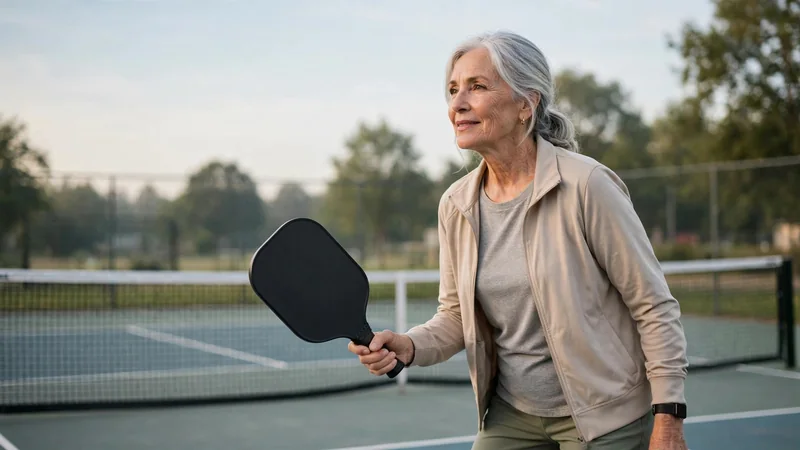
Endurance means a muscle can keep doing its job without fading. In racket sports, the muscles around your shoulder blade (the scapula) and the rotator cuff (a group of small muscles that hold the upper arm bone in its socket) do many small jobs on every swing.
When those muscles tire, many clinicians suggest the arm can start doing more of the work itself. Late in a match, that can feel like a shoulder that is off. Tired players may also reach and swing with less control, which could make a strain or a fall more likely.
For the wider picture, see our guide to shoulder endurance for pickleball players.
What the research says
Pickleball has the clearest injury data. One 10-year analysis found upper-body injuries from the sport rose significantly over the decade, with the highest rates in older adults and women [R31]. A national study reported emergency room visits for pickleball up 88% since 2020. Adults 50 and older made up 91% of reported injuries, and falls were the most common cause [R32].
An earlier study of players aged 60 and older found strains and sprains made up 33% of injuries, and fractures 28% [R33]. These numbers describe injuries, not endurance directly. They do show why staying steady to the end of a match matters.
For exercise, a 2025 review found that scapular stabilization exercise, which trains the muscles around the shoulder blade, improved pain and function in people with rotator-cuff-related pain [R03]. Those studies were about pain, not match play. Whether the same training improves late-match endurance is not tested in these sources, so evidence varies here.
What you can do
- Warm up before you play. Start with slow arm circles and gentle reaches. Keep it short and easy, then begin with lighter swings.
- Build endurance in small, steady doses. Use lighter loads for longer sets rather than heavy, short bursts. Add more over time.
- Train the shoulder blade muscles. Let the blade move smoothly with the arm instead of locking it in place. Seated option: sit tall in a sturdy chair with your back supported, and slide your shoulder blades down and back slowly, several times.
- Plan breaks. Take a short rest between games. Shake out your arms and sip some water.
- Listen to early warning signs. Aching that lingers after play, or a shoulder that grows weak in the last set, is a cue to ease off.
- Give the shoulder a rest day. When it feels tired, skip the hard session. Gentle movement is usually fine.
Where ShoulderBack Pro fits — and where it doesn't
For smooth, repeated control, two of the 16 exercises fit best. Crosscuts is a diagonal glide from high shoulder to opposite hip, and Locomotive is a rolling forward circle for the upper back and rear rotator cuff. One arm resists the other, so you build endurance with longer sets or a little more effort, seated or standing. It is a simple movement tool, not a treatment; nobody has run a clinical trial on it. If your shoulder hurts late in a match, rest it and get it assessed. ShoulderBack Pro is $29 CAD.
When to see a professional
A doctor or physiotherapist diagnoses shoulder problems. They can tell whether a sore shoulder is overuse, a strain or something else.
See a doctor or physiotherapist promptly if you have: pain after a fall or injury with sudden weakness or loss of movement; a shoulder that looks deformed, very swollen or bruised; fever or feeling unwell alongside the pain; chest pain or breathlessness (call emergency services); constant pain that doesn't change with rest or activity; pain that wakes you most nights; numbness, tingling or weakness into the arm or hand; pain in several joints at once; or pain that hasn't improved after a couple of weeks of sensible self-care.
Try this movement
Crosscuts (lats, obliques, scapular retractors) →Frequently asked questions
Is shoulder endurance different from strength?
Yes. Strength is how much force a muscle can make at once. Endurance is how long it can keep working well. Long matches test endurance more than a single hard swing does.
Can I build endurance without a gym?
Often, yes. Slow, controlled movement at home, seated or standing, can build control over time. Ask a clinician first if you have a current shoulder problem.
What if my shoulder hurts late in a match?
Stop that set, rest the shoulder, and avoid pushing through sharp pain. If pain lasts beyond a couple of weeks of sensible self-care, see a clinician.
Are shoulder injuries rising in pickleball?
The data suggest upper-body injuries are. They from the sport rose over the past decade [R31]. Most reported injuries were in adults 50 and older [R32].
Sources
- Pickleball Pains: a 10-year epidemiologic analysis of rising upper-extremity injuries (2014-2023, NEISS). Journal of Orthopaedic Experience & Innovation. https://journaloei.scholasticahq.com/article/160819-pickleball-pains-a-10-year-epidemiologic-analysis-of-rising-upper-extremity-injuries
- ETSU / AOAO 10-year national study (2013-2022, NEISS). https://dc.etsu.edu/asrf/2024/schedule/149
- Weiss H et al. (2021). Pickleball-related injuries (NEISS 2010-2019). Injury Epidemiology (preprint). https://researchsquare.com/article/rs-180980/v1
- Frontiers in Bioengineering & Biotechnology (2025). Specific modes of exercise to improve rotator cuff-related shoulder pain: systematic review and meta-analysis. https://pmc.ncbi.nlm.nih.gov/articles/PMC12011739/