Younger adults: desks, screens, lifting, parenting, travel
Shoulder Pain From Phone Use: 'Text Claw', 'Tech Neck' and the Real Fix
4-minute read · Published November 3, 2026 · Updated November 3, 2026

What this is
"Text claw" describes a rounded, hunched position of the shoulders and hands while texting. "Tech neck" describes the forward head position that comes from looking down at a screen. Both are informal names for a common pattern, not diagnoses.
For the wider desk picture, see the pillar Shoulder Pain From Working at a Computer All Day.
Why this happens
Holding your head forward and your arms in one place for a long time can leave the neck and upper back feeling tight. Posture alone is not the whole story, though. Researchers have not settled whether spinal posture causes back pain [R25], and forward head posture is only associated with neck pain [R27].
What the research says
- Forward head posture is associated with neck pain. Exercise-based programs are the main studied treatment [R27]. "Associated with" is not the same as "causes."
- Exercise can improve the forward angle of the head. Whether that reliably reduces pain is still unsettled [R26].
- For rotator-cuff-related shoulder pain, resisted exercise that progresses over time probably helps. Gentle movement alone probably does not [R01].
- Research on phone use specifically is limited.
What you can do
- Raise the screen. Bring the phone to eye level instead of dropping your head. A stand or a stack of books works, sitting or standing.
- Take regular breaks. Stand or walk often.
- Do a seated shoulder-blade reset. Sit tall, gently draw your shoulder blades back and down, hold for a breath or two, and release. Repeat slowly.
- Build upper-back strength over time. WHO guidance recommends muscle-strengthening activity on at least two days a week [R07]. Resistance that progresses over time is what the shoulder research favours [R01].
Where ShoulderBack Pro fits, and where it doesn't
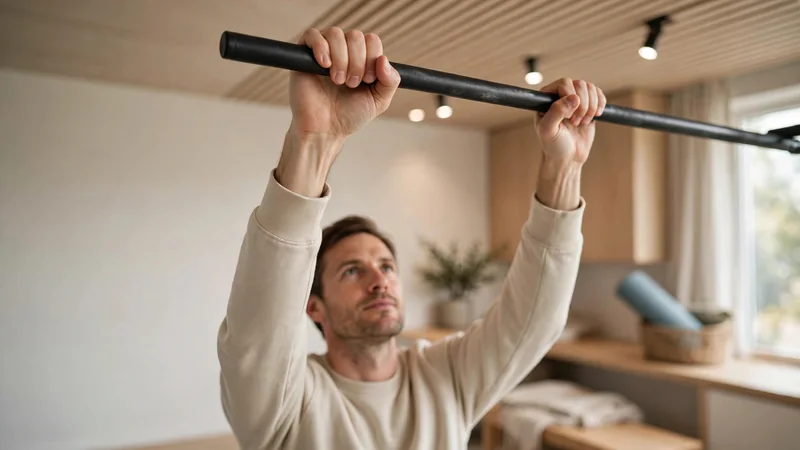
SBP is a reasonable fit for the upper-back part of this. Steering can be done seated and works the deltoids and rhomboids that help control your shoulder blades. Bear Hugs Me draws the 160-gram trainer toward your chest and works the muscles between the shoulder blades. One arm resists the other, so you build up by resisting harder or doing longer sets.
It does not change your phone habit, is not a treatment for neck or shoulder conditions, and has no clinical trials. You can see the trainer here.
When to see a professional
See a doctor or physiotherapist promptly if you have: pain after a fall or injury with sudden weakness or loss of movement; a shoulder that looks deformed, very swollen or bruised; fever or feeling unwell alongside the pain; chest pain or breathlessness (call emergency services); constant pain that doesn't change with rest or activity; pain that wakes you most nights; numbness, tingling or weakness into the arm or hand; pain in several joints at once; or pain that hasn't improved after a couple of weeks of sensible self-care.
Try this movement
Steering (deltoids, rhomboids) →Frequently asked questions
Is text claw a real medical condition?
'Text claw' is an informal name for a common posture pattern, not a diagnosis. Only a clinician can diagnose a shoulder or neck problem.
Do I need to stop using my phone?
No. Most people try smaller changes first: a higher screen, regular breaks and some upper-back strength work. Giving up the phone is rarely necessary.
Will a posture brace help?
The evidence on braces is not clear. Many clinicians suggest movement and strength first. Ask yours before buying one.
Sources
- Naunton J et al. (2020). Effectiveness of progressive and resisted and non-progressive or non-resisted exercise in rotator cuff related shoulder pain: systematic review and meta-analysis of RCTs. Clinical Rehabilitation. https://search.pedro.org.au/search-results/record-detail/61404
- WHO (2020). Guidelines on physical activity and sedentary behaviour (University of Sydney summary). https://www.sydney.edu.au/news-opinion/news/2020/11/26/new-global-guidelines-on-physical-activity-and-sedentary-behavio.html
- Swain CTV et al. (2020). No consensus on causality of spine postures or physical exposure and low back pain: umbrella review of 41 systematic reviews. J Biomechanics. https://getfitcraft.com/guides/exercises-for-posture
- Sheikhhoseini R et al. (2018). Effectiveness of therapeutic exercise on forward head posture: systematic review and meta-analysis. J Manipulative Physiol Ther. https://getfitcraft.com/guides/exercises-for-posture
- Healthcare (MDPI) 2023; 11(19):2604. Treatment of chronic neck pain in patients with forward head posture: systematic narrative review. https://www.mdpi.com/2227-9032/11/19/2604