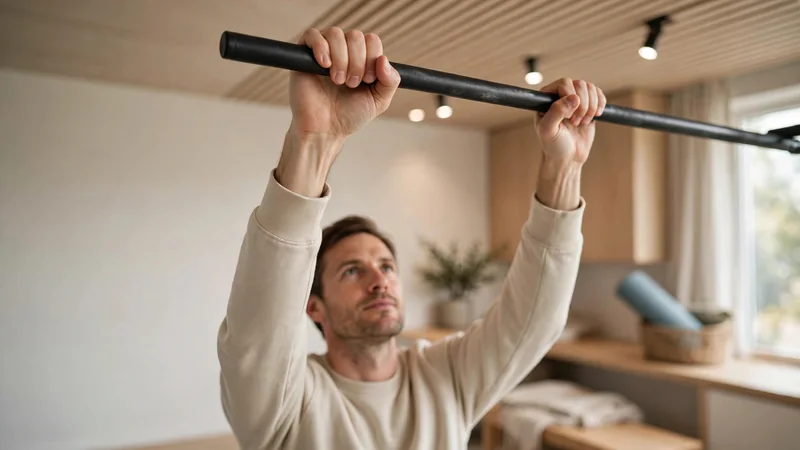
Younger adults: desks, screens, lifting, parenting, travel
Shoulder Care for Musicians: Guitarists, Violinists, Drummers
6-minute read · Published November 3, 2025 · Updated November 3, 2025

What this is
Musicians place their shoulders under unusual demands. A drummer raises the arms repeatedly and reaches across the kit. A violinist or violist holds the arm up and slightly rotated for long periods. A guitarist may hold a strap, a pick and a fretting hand in fixed positions for hours.
Doctors and therapists often call this kind of problem repetitive strain. In plain terms, it means many small loads, repeated over and over, add up faster than the body can recover. The problem is rarely one bad session. It is usually a pattern that builds over weeks.
What the research says
There isn't strong research on musicians specifically; here is the closest evidence on shoulder pain in general.
- Scapular stabilization exercise, which trains the muscles that steady the shoulder blade, improved pain and function in people with shoulder pain [R03].
- Shoulder disorders often go with reduced joint position sense, which is your sense of where the joint is in space. Rehabilitation usually moves from range of motion to strength, then to control and coordination [R16].
- In stroke rehabilitation, training both arms together improved shoulder movement more than one-arm training. That is a reason two-arm work is interesting, but it is not proof for musicians [R14].
What you can do
- Warm up before you play. Start with slow, seated arm circles and gentle shoulder rolls. Keep the range comfortable and the movement easy.
- Plan breaks into practice. Change position, stand up, and let your arms hang loose at natural pauses. Long blocks without a break are a common pattern in strain.
- Check your setup. Look at your chair height, your guitar strap length, your violin or shoulder rest, and how high your drums and cymbals sit. Reaching high or holding a fixed angle for long periods adds strain.
- Build shoulder-blade strength. Use short, controlled sessions a few times a week. Seated pulling and reaching movements are common choices here [R03].
- Keep a practice log. Note how long you played, what hurt, and how you felt the next day. Patterns show up quickly in a log.
- Ask a teacher for input. A teacher can often spot a tense posture or an awkward reach that you cannot see yourself.
Where ShoulderBack Pro fits, and where it doesn't
ShoulderBack Pro can cover one piece: a short seated reset between practice blocks. Steering (turning an imaginary wheel at ten-and-two, designed to work the deltoids and rhomboids) and Bear Hugs Me (drawing the trainer to your chest, aimed at the middle trapezius) take the shoulder blades through a pulling range that playing rarely uses, with your other arm providing the resistance. Try the Steering lesson.
It won't change your technique, your setup or your practice volume, and those usually matter more. It's a wellness tool with no clinical trials behind it, so it is not a treatment for any condition. If you want to try it, it's available online.
For a broader look at desk and screen habits that can overlap with musicians' posture, read shoulder pain from working at a computer all day. The 17 muscles of the shoulder blade guide explains the muscles most often involved.
When to see a professional
See a doctor or physiotherapist promptly if you have: pain after a fall or injury with sudden weakness or loss of movement; a shoulder that looks deformed, very swollen or bruised; fever or feeling unwell alongside the pain; chest pain or breathlessness (call emergency services); constant pain that doesn't change with rest or activity; pain that wakes you most nights; numbness, tingling or weakness into the arm or hand; pain in several joints at once; or pain that hasn't improved after a couple of weeks of sensible self-care.
For musicians, numbness, tingling or weakness in the hand while playing needs an assessment before you keep playing through it. These warning signs come from shoulder red-flag guidance. A doctor or physiotherapist diagnoses the cause.
Try this movement
Steering (deltoids, rhomboids) →Frequently asked questions
Should I stop playing if my shoulder hurts?
Not always. Reducing the load, changing your setup and taking breaks is often enough at first. See a clinician if pain changes how you play, wakes you at night, or lingers after rest.
Can a teacher or physiotherapist help with my setup?
Often, yes. A physiotherapist who works with musicians, or an experienced teacher, can look at how you hold your instrument, where your arms sit and how long you practise without a break.
Is ShoulderBack Pro useful for drummers?
It can be a short, seated routine between sessions. It does not replace a setup change or a clinical assessment, and it cannot address overuse from practice volume.
Sources
- Frontiers in Bioengineering & Biotechnology (2025). Specific modes of exercise to improve rotator cuff-related shoulder pain: systematic review and meta-analysis. https://pmc.ncbi.nlm.nih.gov/articles/PMC12011739/
- Journal of Physical Therapy Science (2016). The effects of bilateral movement training on upper limb function in chronic stroke patients. https://pmc.ncbi.nlm.nih.gov/articles/PMC5011582
- Muresan et al. (2022). Effects of a novel proprioceptive rehabilitation device on shoulder joint position sense, pain and function. Medicina. https://www.ncbi.nlm.nih.gov/pmc/articles/PMC9505091/