Younger adults: desks, screens, lifting, parenting, travel
Pilates and Shoulders: What It Trains Well and What It Misses
4-minute read · Published April 23, 2026 · Updated April 23, 2026
Why this happens / What this is
Pilates focuses on control. Classes often emphasise the deep trunk muscles, breathing, alignment and slow, deliberate movement. Some moves ask the arms to reach, press or pull while the trunk stays steady.
That can train shoulder-blade control, which matters because the shoulder blade (scapula) is the base for arm movement. A steady trunk gives the arms a stable place to work from.
What the research says
- Control and coordination may help. Programs that teach control may edge out generic exercise for shoulder disability in the short and medium term, though we don't fully know why [R02]. That research is about rotator-cuff programs, not Pilates classes.
- Progressive resistance probably helps. Resisted, progressive exercise probably helps shoulder pain. Gentle unloaded movement alone probably does not move the needle on pain [R01].
- Resistance training supports older adults. Resistance training supports strength, function and independence in older adults [R06].
- There isn't strong research on Pilates for shoulders specifically; the points above are the closest evidence. Ask your clinician if you have a shoulder problem.
What you can do
Related reading: Shoulder pain from working at a computer all day.
- Choose a chair-based or seated class. Many classes offer chair work. Tell the instructor about your shoulder before you start.
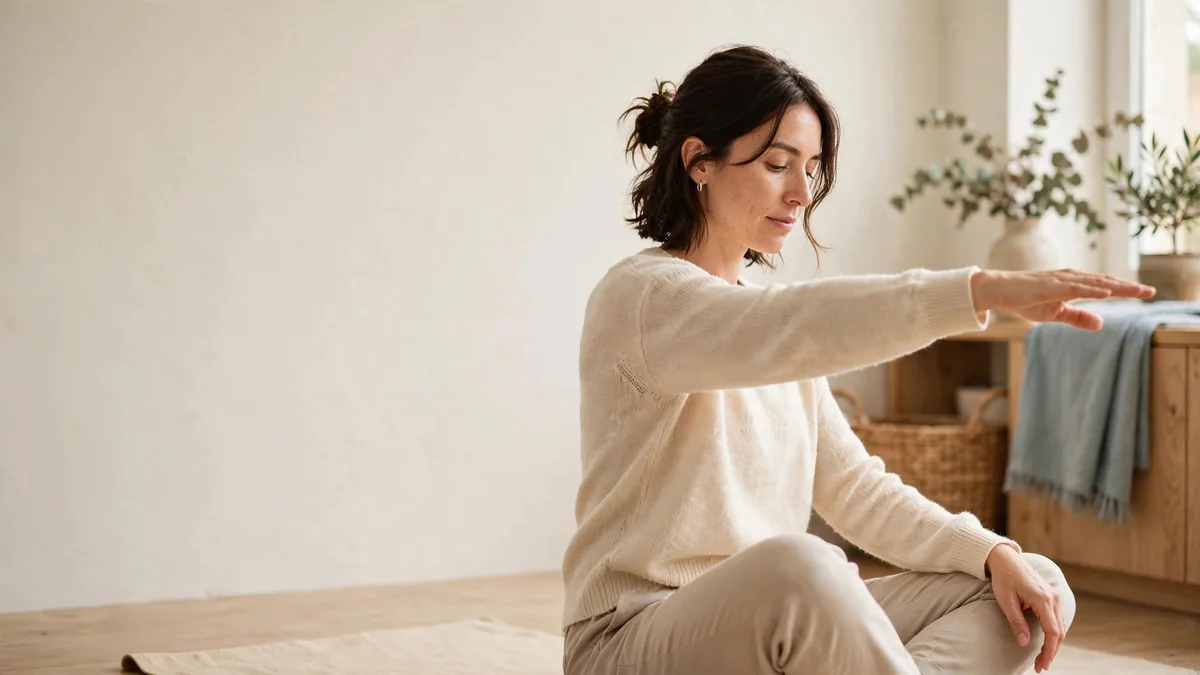
- Reach with a steady trunk. Sit tall, reach the arms forward, and keep the ribs soft. Avoid shrugging the shoulders up.
- Add a short strength session. Slow arm movements where one arm resists the other, resisting a little harder or moving through more range over time, can complement Pilates.
- Stop at sharp pain. Mild effort is fine. Sharp or pinching pain is a signal to stop.
- Ask before overhead reaches. Check with your clinician before overhead work, especially with a sore shoulder.
Where ShoulderBack Pro fits — and where it doesn't
ShoulderBack Pro covers one slice of the plan: self-resisted arm work, seated or standing, where one arm resists the other. Steering (turn an imaginary wheel, ten-and-two) is designed to work the deltoids and rhomboids, and you set how hard to resist. See the Steering lesson.
It does not train the core, hips or whole body the way a good class does, so the trainer is an add-on to Pilates, not a replacement. It's a wellness tool, not a treatment, and there are no clinical trials of it yet.
When to see a professional
See a doctor or physiotherapist promptly if you have: pain after a fall or injury with sudden weakness or loss of movement; a shoulder that looks deformed, very swollen or bruised; fever or feeling unwell alongside the pain; chest pain or breathlessness (call emergency services); constant pain that doesn't change with rest or activity; pain that wakes you most nights; numbness, tingling or weakness into the arm or hand; pain in several joints at once; or pain that hasn't improved after a couple of weeks of sensible self-care. [R30]
Try this movement
Steering (deltoids, rhomboids) →Frequently asked questions
Is Pilates good for shoulders?
It may help control and posture. Our sources do not test Pilates for shoulders directly, so a class is a reasonable choice if you enjoy it and keep going.
Can Pilates hurt my shoulder?
It can aggravate a sore shoulder if you push into pain. Tell your instructor and clinician what hurts.
Should I choose Pilates or strength training?
For most people it does not have to be one or the other. Choosing exercise you will keep doing matters most.
Sources
- Naunton J et al. (2020). Effectiveness of progressive and resisted and non-progressive or non-resisted exercise in rotator cuff related shoulder pain: systematic review and meta-analysis of RCTs. Clinical Rehabilitation. https://search.pedro.org.au/search-results/record-detail/61404
- Dubé M-O et al. (2024). The Efficacy of Exercise Therapy for Rotator Cuff-Related Shoulder Pain According to the FITT Principle: Systematic Review With Meta-analyses. JOSPT. https://pubmed.ncbi.nlm.nih.gov/38848304/
- Fragala MS, Cadore EL, Dorgo S et al. (2019). Resistance Training for Older Adults: Position Statement From the National Strength and Conditioning Association. J Strength Cond Res. https://pubmed.ncbi.nlm.nih.gov/31343601/
- NHS Greater Glasgow & Clyde, Shoulder red flags; NHS MPFT self-help, Shoulder pain; BESS/BOA pathway summary (2021). https://pmc.ncbi.nlm.nih.gov/articles/PMC7905504