Active aging & sports: keep playing
Paddleboarding and Shoulders: Prep for a Full Day on the Water
4-minute read · Published July 9, 2025 · Updated July 9, 2025
Why this happens
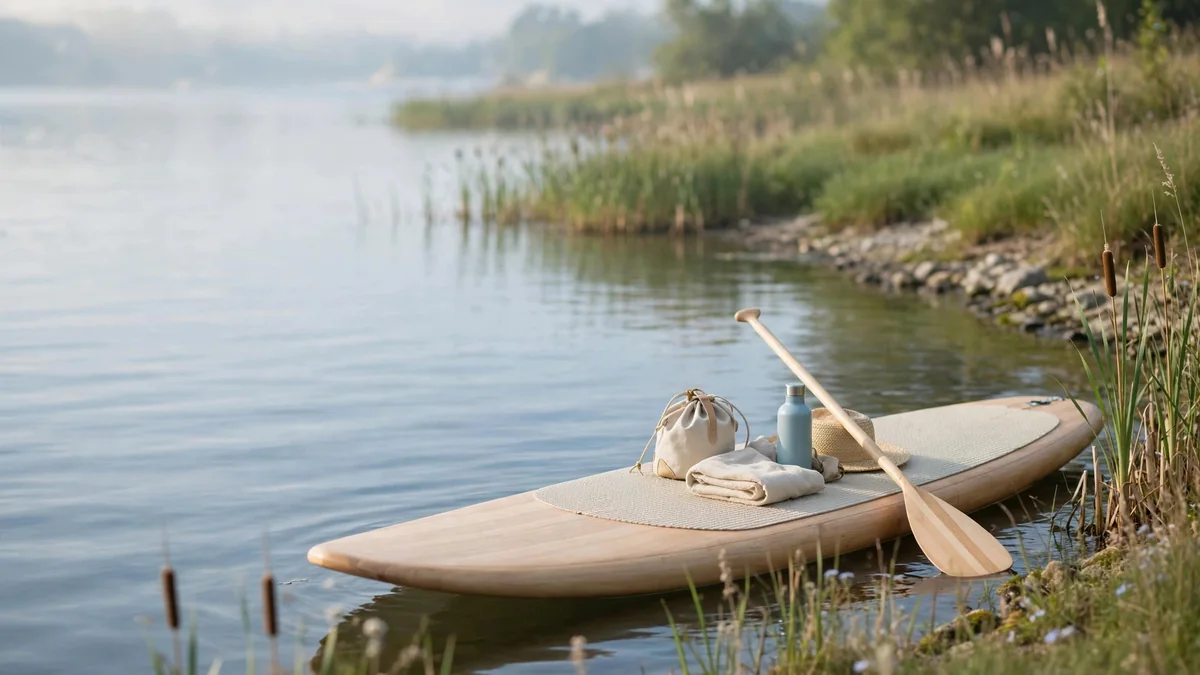
On a board, your shoulders do a long run of forward reaches and pulls. Your upper back turns with each stroke, and your legs and core keep you upright. When the shoulders tire, the stroke gets shorter and the balance gets harder, which can make the whole day feel shaky.
The shoulder blade (scapula) guides every stroke. The upper back carries the turn. Many people who sit for long periods find both stiff, which is one reason a short warm-up can feel so good before a long paddle.
What the research says
Activity guidance for adults and older adults includes both strength and balance. The WHO recommends muscle-strengthening activity at least two days a week, and for adults 65 and older, multicomponent activity that builds functional balance and strength on at least three days a week [R07].
A 12-week program of yoga twice a week improved standing balance and mobility in adults around 68 years old [R12]. That was a small pilot trial of yoga, not paddleboarding, so it is a hint about balance training in general.
What you can do
- Seated shoulder reach. Sit tall on a stable chair. Reach both arms forward slowly, then open them to the sides. Repeat a few times.
- Seated paddle turn. Hold a light, empty grip at chest height. Turn your upper body gently to each side, keeping your hips still, as if reaching for a stroke.
- Standing balance with support. Stand near a wall or counter with feet hip-width apart. Shift your weight slowly from side to side, then back to centre.
- Shoulder-blade squeeze. Sitting tall, draw your shoulder blades gently back and down, hold for a breath, then release.
- Short standing reach. With a hand on a counter, reach one arm forward and up, then return. Switch sides. Keep the movement smooth.
- Rest between laps. Set the paddle down, stretch your arms overhead, and take a few slow breaths before you go again.
Where ShoulderBack Pro fits, and where it doesn't
Crosscuts is a diagonal glide from high shoulder to opposite hip, close to the reach and pull of a paddle stroke; the site lists it as working the lats and shoulder-blade retractors. Try it seated first if that feels steadier.
The resistance comes from your other arm, so you set the effort; progress by resisting harder, moving through more range or doing longer sets. It is a wellness tool, not a treatment, has no clinical trials, and is not a balance program. A leash and life jacket matter more. It is available in the shop.
When to see a professional
See a doctor or physiotherapist promptly if you have: pain after a fall or injury with sudden weakness or loss of movement; a shoulder that looks deformed, very swollen or bruised; fever or feeling unwell alongside the pain; chest pain or breathlessness (call emergency services); constant pain that doesn't change with rest or activity; pain that wakes you most nights; numbness, tingling or weakness into the arm or hand; pain in several joints at once; or pain that hasn't improved after a couple of weeks of sensible self-care.
A doctor or physiotherapist diagnoses any shoulder problem. Dizziness, fainting or a fall on the water needs a medical check before you paddle again.
Try this movement
Crosscuts (lats, obliques, scapular retractors) →Frequently asked questions
Is paddleboarding harder on the shoulders than kayaking?
Both use repeated paddling. Standing adds balance demands, so keep your prep steady and your first sessions short. The research here does not compare the two sports directly.
What if I feel unsteady when I stand to paddle?
Practise standing with a wall or railing nearby, and sit down if you feel dizzy. Dizziness or a fall needs a check with your doctor.
Can ShoulderBack Pro help with balance?
ShoulderBack Pro is not a balance program. It can be part of controlled, two-arm movement at home, but it does not replace balance training or a clinician's advice.
Sources
- WHO (2020). Guidelines on physical activity and sedentary behaviour (University of Sydney summary). https://www.sydney.edu.au/news-opinion/news/2020/11/26/new-global-guidelines-on-physical-activity-and-sedentary-behavio.html
- Tiedemann A et al. (2013). A 12-week Iyengar yoga program improved balance and mobility in older community-dwelling people: pilot RCT. Journal of Gerontology A. https://www.qigonginstitute.org/abstract-print/9524