Younger adults: desks, screens, lifting, parenting, travel
Overhead Press Shoulder Pain: Mobility, Technique and When to Back Off
5-minute read · Published September 19, 2025 · Updated September 19, 2025

Why this happens / What this is
An overhead press asks the shoulder to lift the arm above the head while carrying a load. The shoulder blade (scapula) has to rotate upward to make room for the arm. If mobility, control or strength falls short, the joint and the tissues around it can be overloaded.
Lifters often call this "shoulder pain." It is a pattern, not a diagnosis. Your sense of where your arm is in space, called proprioception or joint position sense, also plays a part in steady movement. Shoulder disorders are linked to reduced joint position sense [R16].
Only a doctor or physiotherapist can diagnose the cause of your pain.
What the research says
- Rehabilitation usually moves through stages: range of motion first, then strength, then motor control and proprioception, then full coordination [R16].
- For rotator-cuff-related shoulder pain, progressive resisted exercise probably helps. Unloaded movement alone probably does not [R01].
- A 2025 review found that scapular stabilization exercise, which trains control of the shoulder blades, improved pain and function [R03].
- Most shoulder pain is managed with advice and exercise, but sudden severe pain after an injury needs proper diagnosis [R30].
What you can do
Each step can be done seated.
- Lower the load before the lift. Reduce the weight, or the range, until you can press with steady control and no sharp pain.
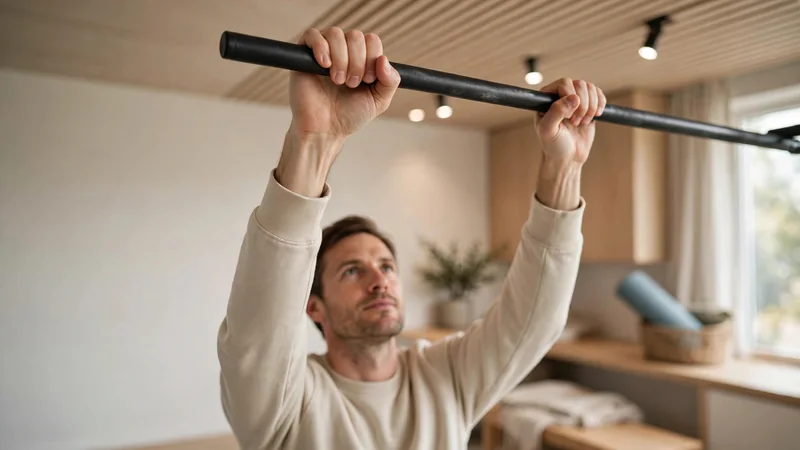
- Reach overhead seated. Sit tall and lift one arm slowly, as if placing a teacup on a high shelf. Lower with control. Switch arms.
- Press lightly, then build. Once reaching feels steady, try a light seated press. Add a small amount of load only when the last session felt calm.
- Track your pain. Note whether pain appears during the lift, during lowering, or the next morning. Pain that clears within a day is useful information. Pain that stays is a reason to get help.
- Check your setup. Keep your ribs down and avoid arching hard through the low back to finish the lift.
- Rest and build back. Give the shoulder time between sessions, and build back gradually.
Where ShoulderBack Pro fits — and where it doesn't
The part ShoulderBack Pro can help with is slow, low-load reaching. Overhead Press (High Shelf Reach) rehearses the overhead path with no weight, and Steering keeps the deltoids and rhomboids working with control. Both can be done seated, with one arm resisting the other.
It is a wellness tool, not a treatment, and it won't build heavy strength or fix pressing technique. Lifters who need load still need dumbbells or a coached program, and persistent pain needs a clinician first. Details are on the shop page.
When to see a professional
See a doctor or physiotherapist promptly if you have: pain after a fall or injury with sudden weakness or loss of movement; a shoulder that looks deformed, very swollen or bruised; fever or feeling unwell alongside the pain; chest pain or breathlessness (call emergency services); constant pain that doesn't change with rest or activity; pain that wakes you most nights; numbness, tingling or weakness into the arm or hand; pain in several joints at once; or pain that hasn't improved after a couple of weeks of sensible self-care.
Sudden pain during a heavy lift, or a pop with weakness, needs prompt assessment. Do not wait and see.
Try this movement
Steering (deltoids, rhomboids) →Frequently asked questions
Is shoulder pain from overhead pressing always serious?
No, but do not ignore it. Persistent or sharp pain, or pain with weakness, deserves an assessment.
Should I push through the pain?
No. Pain that spikes sharply, lingers, or changes how you move is a signal to ease off.
Can I train overhead with a seated option?
Yes. Seated reaching and pressing with lighter loads let you keep moving while you rebuild control.
Can a movement trainer replace strength work?
No. A movement trainer can be a low-load way to practise overhead reach. It does not replace strength training or a clinician's plan.
Sources
- Mureşan et al. (2022). Effects of a novel proprioceptive rehabilitation device on shoulder joint position sense, pain and function. Medicina. https://www.ncbi.nlm.nih.gov/pmc/articles/PMC9505091/
- Naunton J et al. (2020). Effectiveness of progressive and resisted and non-progressive or non-resisted exercise in rotator cuff related shoulder pain: systematic review and meta-analysis of RCTs. Clinical Rehabilitation. https://search.pedro.org.au/search-results/record-detail/61404
- Frontiers in Bioengineering & Biotechnology (2025). Specific modes of exercise to improve rotator cuff-related shoulder pain: systematic review and meta-analysis. https://pmc.ncbi.nlm.nih.gov/articles/PMC12011739/
- NHS Greater Glasgow & Clyde, Shoulder red flags; NHS MPFT, Shoulder pain self-help; BESS/BOA pathway summary (2021). https://pmc.ncbi.nlm.nih.gov/articles/PMC7905504