Rotator cuff & shoulder strength
External Rotation Exercises: The Movement Most Shoulders Are Missing
5-minute read · Published March 23, 2026 · Updated March 23, 2026
Why this happens / What this is
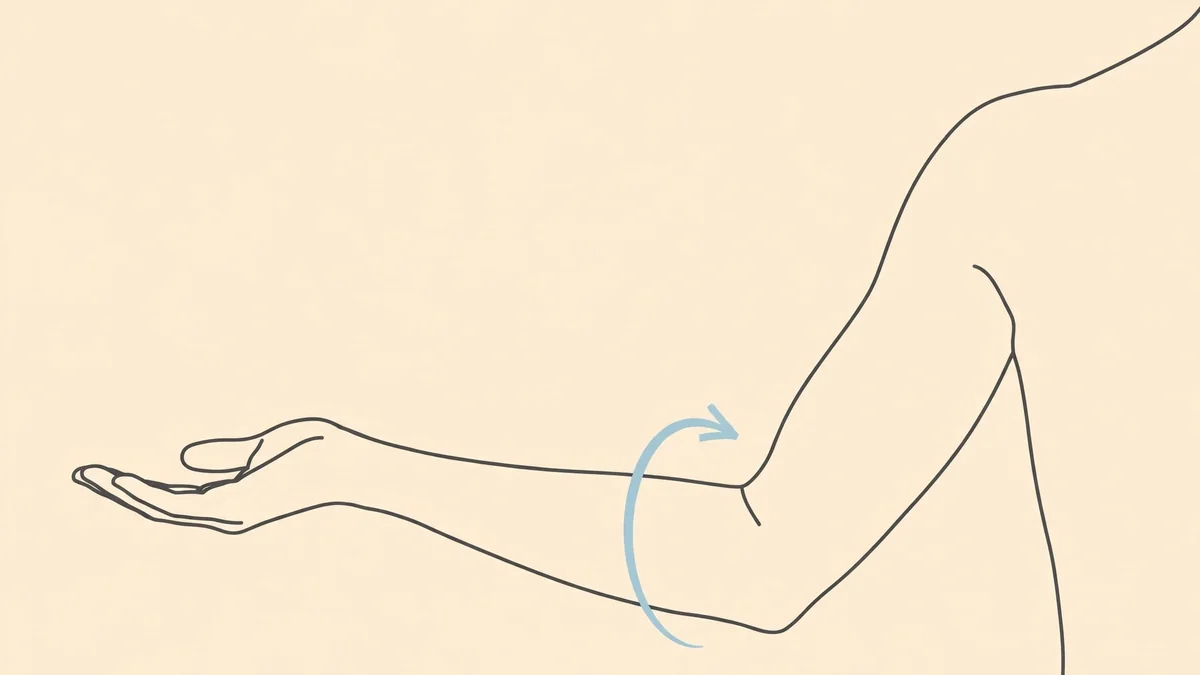
External rotation is the movement of turning the arm outward while the elbow stays bent near the side. It is a small but important movement. It helps keep the ball of the shoulder centred in its socket as you reach, reach back, and carry things.
The muscles that do this sit at the back and side of the shoulder blade. They are part of the rotator cuff, a group of small muscles that steady the joint.
Most daily life involves inward rotation, such as reaching for a seatbelt or hugging. Many people rarely turn the arm outward against any resistance. That is a common pattern, not a diagnosis.
What the research says
A 2025 review of exercise types found that scapular stabilization exercise improved pain and function, and that the rotator cuff condition includes subacromial pain, tendinopathy and symptomatic tears [R03].
Exercise with resistance that builds gradually is the type most likely to help in rotator-cuff-related shoulder pain. Non-resisted, non-progressive exercise did not show a clear benefit on pain [R01]. The size of the benefit is uncertain, so read these findings as a direction, not a promise.
Programs that teach control and coordination may edge out generic exercise, though the reasons are not fully understood [R02]. Exercise interventions also improved pain and range of motion in middle-aged and older adults [R04].
What you can do
- Sit tall with back support. Keep your feet flat and your shoulders relaxed.
- Tuck your elbows. Keep them at your sides, bent to about a right angle.
- Move the forearms outward slowly. Keep the upper arm still and move only the forearm, out and back.
- Use light resistance. With a self-resisted trainer, the other arm pushes back; start with very little, and resist harder or add range only when the movement feels easy and controlled.
- Rest between sets. Stop before sharp pain, and watch how you feel the next morning.
Where ShoulderBack Pro fits, and where it doesn't
Open the Door is the direct match: elbows at your sides, forearms swinging outward, with the site listing the infraspinatus among its targets. Because the other arm supplies the resistance, you progress by resisting harder, swinging through more range, or adding sets.
Windshield Wipers adds slow side-to-side arcs for the rotator cuff. Both work seated. It is a wellness tool, not a treatment for a diagnosed cuff problem, and there are no clinical trials of it yet.
When to see a professional
See a doctor or physiotherapist promptly if you have: pain after a fall or injury with sudden weakness or loss of movement; a shoulder that looks deformed, very swollen or bruised; fever or feeling unwell alongside the pain; chest pain or breathlessness (call emergency services); constant pain that doesn't change with rest or activity; pain that wakes you most nights; numbness, tingling or weakness into the arm or hand; pain in several joints at once; or pain that hasn't improved after a couple of weeks of sensible self-care.
A doctor or physiotherapist should assess weakness after a fall, or any sudden loss of movement, before you start. They diagnose the cause.
Keep reading: Cluster guide · Do rotator cuff exercises work? · Infraspinatus
Try this movement
Open the Door (infraspinatus, rhomboids) →Frequently asked questions
What is external rotation?
It is turning the arm outward, away from the body, while the elbow stays bent near the side. It works the small rotator cuff muscles at the back of the shoulder.
Should I use resistance for external rotation?
Research suggests that resisted exercise that progresses over time probably helps rotator-cuff-related pain more than unloaded movement alone. Start light, and build slowly.
Can I do external rotation seated?
Yes. Sit tall with your back supported, keep elbows at your sides, and move the forearms outward slowly and under control.
When should I see a clinician first?
See a clinician before starting if you have sudden weakness, a fall or injury, numbness or tingling, or pain that wakes you at night.
Sources
- Naunton J et al. (2020). Effectiveness of progressive and resisted and non-progressive or non-resisted exercise in rotator cuff related shoulder pain: systematic review and meta-analysis of RCTs. Clinical Rehabilitation. https://search.pedro.org.au/search-results/record-detail/61404
- Dubé M-O et al. (2024). The Efficacy of Exercise Therapy for Rotator Cuff-Related Shoulder Pain According to the FITT Principle: Systematic Review With Meta-analyses. JOSPT. https://pubmed.ncbi.nlm.nih.gov/38848304/
- Frontiers in Bioengineering & Biotechnology (2025). Specific modes of exercise to improve rotator cuff-related shoulder pain: systematic review and meta-analysis. https://pmc.ncbi.nlm.nih.gov/articles/PMC12011739/
- BMC Musculoskeletal Disorders (2026). Exercise interventions for rotator cuff-related shoulder pain in middle-aged and older adults: systematic review and meta-analysis. https://link.springer.com/10.1186/s12891-026-10035-4