Active aging & sports: keep playing
Building Strength and Range of Motion for the Activities You Love
5-minute read · Published May 27, 2026 · Updated May 27, 2026

Why this happens / What this is
Range and strength are two different jobs. Range is how far your shoulder can move. Strength is how much load you can control through that movement. Most sports and daily tasks need both, and many people focus on one while neglecting the other.
Muscle loss becomes more noticeable with age. Sarcopenia, the age-related loss of muscle, affects almost one in three older people. Losing muscle is not inevitable, and resistance exercise is the first-line approach. No drug currently does that job [R08].
What the research says
- Resistance training in older adults counters loss of strength and muscle, and supports function, mobility, independence and quality of life [R06].
- WHO guidance asks adults to do muscle-strengthening activity on at least two days a week. Adults 65 and older should add multicomponent activity that emphasizes balance and strength on at least three days [R07].
- Exercise that adds resistance and progresses over time probably helps rotator-cuff-related shoulder pain. Gentle, unloaded movement alone probably does not move pain much [R01].
What you can do
- Start with the range you have. Use gentle reaches, seated or standing, to find where the shoulder moves freely and where it pinches.
- Add light, controlled resistance two days a week. Use a band, a light dumbbell or the trainer (which is resisted by your other arm). Choose a load you can control from start to finish.
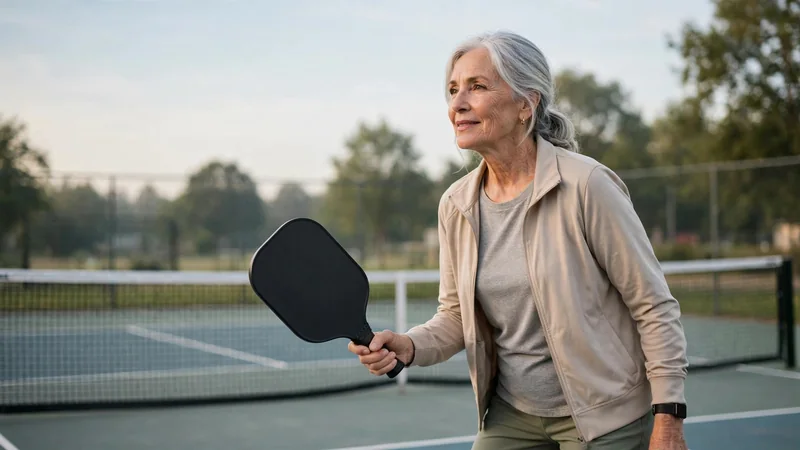
- Train the patterns your sport uses. Reaching, pulling and overhead work all matter for golf, pickleball, gardening and lifting.
- Progress slowly. Add a little range or resistance only when the last set felt controlled.
- Include balance and leg strength. If you are 65 or older, WHO recommends balance and strength work on at least three days a week. Seated leg work and sit-to-stand practice are good options.
- Respect the pain signal. A dull effort is normal. Sharp pain means stop.
Seated option: rows with a band, seated leg lifts and seated overhead reaches all work well from a sturdy chair.
Where ShoulderBack Pro fits — and where it doesn't
For range and control, two of the 16 exercises fit. Crosscuts is a diagonal glide from high shoulder to opposite hip, which the site lists as working the lats, obliques and scapular retractors, useful for reaching and rotating. Overhead Press (High Shelf Reach) lifts the arms as if placing a teacup on a high shelf, a full-range overhead pattern.
The limit is strength. The resistance comes from your other arm, so you can progress by resisting harder, moving through more range or doing longer sets, but you cannot add load the way you can with a band or dumbbells. If strength is the main goal, start there. The trainer is a wellness tool with no clinical trials. It is $29 CAD ($87 for a 4-pack) with a 30-day guarantee on the product page.
When to see a professional
See a doctor or physiotherapist promptly if you have: pain after a fall or injury with sudden weakness or loss of movement; a shoulder that looks deformed, very swollen or bruised; fever or feeling unwell alongside the pain; chest pain or breathlessness (call emergency services); constant pain that doesn't change with rest or activity; pain that wakes you most nights; numbness, tingling or weakness into the arm or hand; pain in several joints at once; or pain that hasn't improved after a couple of weeks of sensible self-care.
If you are returning to a sport after an injury, a physiotherapist can help you plan the build-up.
Try this movement
Crosscuts (lats, obliques, scapular retractors) →Frequently asked questions
How often should I train for shoulder strength?
The WHO recommends muscle-strengthening activity on at least two days a week for adults. Adults 65 and older should add balance and multicomponent work on at least three days.
Can I do this if I play pickleball or golf?
Yes, and the same logic applies. Build range and control first, then add load gradually. A clinician can help you choose what suits your sport and your shoulder.
Is ShoulderBack Pro enough for strength?
Usually not on its own. Its resistance comes from your other arm, so you cannot add weight the way you can with a band or dumbbell. It is best used for range, control and coordination.
What if an exercise hurts?
A dull effort is normal. Sharp pain is a signal to stop, and pain that lingers the next morning should be checked by a clinician.
Sources
- Naunton J et al. (2020). Effectiveness of progressive and resisted and non-progressive or non-resisted exercise in rotator cuff related shoulder pain: systematic review and meta-analysis of RCTs. Clinical Rehabilitation. https://search.pedro.org.au/search-results/record-detail/61404
- Fragala MS, Cadore EL, Dorgo S et al. (2019). Resistance Training for Older Adults: Position Statement From the National Strength and Conditioning Association. J Strength Cond Res. https://pubmed.ncbi.nlm.nih.gov/31343601/
- WHO (2020). Guidelines on physical activity and sedentary behaviour. https://www.sydney.edu.au/news-opinion/news/2020/11/26/new-global-guidelines-on-physical-activity-and-sedentary-behavio.html
- Australian/NZ sarcopenia guidelines summary (2025). Journal of Cachexia, Sarcopenia and Muscle via Medical Republic. https://medicalrepublic.com.au/how-to-stop-muscle-loss-in-older-people/81501