Rotator cuff & shoulder strength
Why Shoulder Strength Involves Much More Than the Rotator Cuff
6-minute read · Published June 30, 2026 · Updated June 30, 2026
Why this happens
Think of the shoulder as a moving base rather than a single joint. The arm attaches to the shoulder blade, and the shoulder blade sits on the rib cage. For the arm to lift overhead or reach across your body, many muscles have to coordinate.
The rotator cuff holds the ball of the joint in place and helps rotate the arm. The shoulder blade muscles, including the serratus anterior and the trapezius, set the platform. The lats, chest and upper back carry load. When one part of the team is weak or late to switch on, the others may work harder than they should.
This is a useful way to think about strength, but it is not a diagnosis. Any pain or weakness that is new or unclear deserves an assessment.
What the research says
- Specific exercise types differ in what they target. A 2025 review found that scapular stabilization exercise improved pain and function in rotator cuff-related shoulder pain [R03]. Training the shoulder blade is part of the picture, not an extra.
- Strength, mobility, body composition and posture were each associated with shoulder pain and disability in adults 60 and older. Forward head posture evidence in this group is limited and indirect [R28]. These are targets to work on, not proof of cause.
- Exercise that adds resistance and progresses over time probably helps shoulder pain, while gentle movement without load probably does not move pain much [R01].
- Resistance training supports function, mobility and independence for older adults [R06]. The position statement stresses that fears and barriers should be addressed, not ignored.
- Proprioception, or joint position sense, is reduced in shoulder disorders, and it influences how accurately you move [R16].
What you can do
- Start with the shoulder blade. Seated option: sit tall, let your arms rest, and gently draw your shoulder blades down and back. Hold for a breath, then release.
- Add a rotation. Keep elbows at your sides and move your forearms outward slowly. This works the infraspinatus and rhomboids.
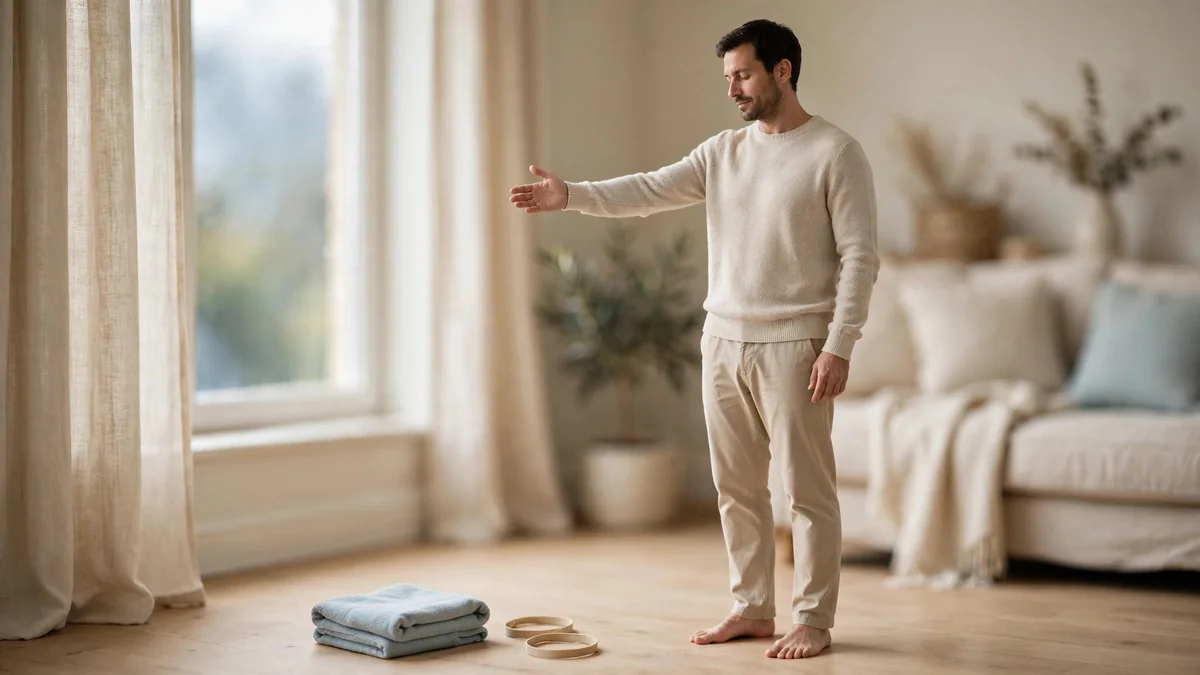
- Reach with control. Stand or sit, and reach one arm forward and up within a comfortable range. Lower it with the same care.
- Train both sides. Using both arms keeps the routine balanced and helps you notice differences.
- Progress slowly. Unresisted reaching builds control more than strength, so add resistance (your other hand pressing back, or a light band), more range, or longer sets over several weeks. Stop short of sharp pain.
- Keep a steady schedule. The World Health Organization suggests muscle-strengthening work at least two days a week for adults [R07]. Short sessions most days are easier to keep.
For the bigger picture of rotator cuff work, read our guide to rotator cuff exercises at home. You may also find it useful to read do rotator cuff exercises actually work and shoulder strength versus stability.
Where ShoulderBack Pro fits — and where it doesn't
ShoulderBack Pro gets its resistance from your own other arm, which makes it a fair fit for this "team" idea. Open the Door is designed to work the infraspinatus and rhomboid major, and Around the World the serratus anterior and lower trapezius. Both can be done seated or standing, and you progress by resisting harder, moving through more range, or doing longer sets.
It is a wellness tool, not a treatment, and there are no clinical trials of it yet; it will not replace a heavier progressive plan from a professional. The trainer is $29 CAD at the shop, with a 30-day guarantee. If you have pain, weakness or a recent injury, get an assessment first.
When to see a professional
See a doctor or physiotherapist promptly if you have: pain after a fall or injury with sudden weakness or loss of movement; a shoulder that looks deformed, very swollen or bruised; fever or feeling unwell alongside the pain; chest pain or breathlessness (call emergency services); constant pain that doesn't change with rest or activity; pain that wakes you most nights; numbness, tingling or weakness into the arm or hand; pain in several joints at once; or pain that hasn't improved after a couple of weeks of sensible self-care.
A doctor or physiotherapist diagnoses the cause of any shoulder pain or weakness. If you are returning to strength work after a health problem, ask your clinician what is safe for you.
Try this movement
Open the Door (infraspinatus, rhomboids) →Frequently asked questions
If the rotator cuff is weak, is that the only thing to train?
No. The shoulder blade muscles, upper back and trunk all affect how the arm moves and how much load the cuff carries. Training the whole team tends to make more sense than focusing on one muscle.
Do I need weights to build shoulder strength?
Not necessarily. Resistance can come from your own arm, a band, a partner or a controlled movement tool. What matters is that the load gradually increases over time.
How often should I train?
Most public health guidance suggests muscle-strengthening work at least two days a week for adults, with more for older adults [R07]. Start where you are and build up.
Is strength training safe after 60?
Resistance training is widely recommended for older adults, and it supports function and independence [R06]. Check with a clinician first if you have a health condition or a recent injury.
Sources
- Naunton J et al. (2020). Effectiveness of progressive and resisted and non-progressive or non-resisted exercise in rotator cuff related shoulder pain: systematic review and meta-analysis of RCTs. Clinical Rehabilitation. https://search.pedro.org.au/search-results/record-detail/61404
- Frontiers in Bioengineering & Biotechnology (2025). Specific modes of exercise to improve rotator cuff-related shoulder pain: systematic review and meta-analysis. https://pmc.ncbi.nlm.nih.gov/articles/PMC12011739/
- Fragala MS, Cadore EL, Dorgo S et al. (2019). Resistance Training for Older Adults: Position Statement From the National Strength and Conditioning Association. J Strength Cond Res. https://pubmed.ncbi.nlm.nih.gov/31343601/
- WHO (2020). Guidelines on physical activity and sedentary behaviour. https://www.sydney.edu.au/news-opinion/news/2020/11/26/new-global-guidelines-on-physical-activity-and-sedentary-behavio.html
- Mureşan et al. (2022). Effects of a novel proprioceptive rehabilitation device on shoulder joint position sense, pain and function. Medicina. https://www.ncbi.nlm.nih.gov/pmc/articles/PMC9505091/
- PMC narrative review (2026). Body composition, strength, mobility and posture associated with shoulder pain and disability in community-dwelling older adults. https://www.ncbi.nlm.nih.gov/pmc/articles/PMC13513864/