Mobility, stiffness & range of motion
Why Do Shoulders Get Stiff as We Get Older? (And What Actually Helps)
11-minute read · Published June 10, 2026 · Updated June 10, 2026

Stiffness is one of the most common complaints we hear, so this guide tries to explain it clearly. If you want the basics first, read How the Shoulder Works. For related reading, see Why Stretching Alone Doesn't Fix Stiff Shoulders and Shoulder Stiffness After Sitting.
What "stiff" usually means
Stiffness is the feeling that your shoulder will not move as easily as it used to. You might notice it when you reach for a high shelf, put on a coat, or fasten a bra behind your back. For many people, the shoulder loosens up after a few minutes of movement.
Stiffness is a symptom, not a diagnosis. It can come from several places: the muscles around the blade, the tendons that cross the joint, the joint capsule (the sleeve of tissue around the ball of the joint), or the spine and ribs the shoulder sits on. A clinician sorts out which one is involved.
Why it happens with age
Several changes build up over the years. No single one explains everything, and they often work together:
- Strength changes. Muscle strength and mass tend to decline with age unless we keep training. Less strength can mean less confidence in the range we do have.
- Less varied movement. Many people reach overhead less often as they get older. Joints and muscles that are not used through their full range often feel tighter.
- Posture and sitting. Long periods seated can leave the upper back rounded and the shoulders forward. Posture's link to pain is less clear than many people assume, but it may influence how the blade moves.
- Body composition. The amount of muscle and fat each person carries also plays a part.
Research on older adults links strength, mobility, body composition and posture to shoulder pain and disability. These are things we can influence. The evidence on posture alone is limited and indirect [R28].
What the research says
Exercise is the best-supported approach here, though the studies are not all about stiffness specifically:
- Exercise-based programs in middle-aged and older adults reduced shoulder pain and improved function and range of motion [R04]. The review was checked from its abstract only.
- Frozen shoulder is different from age-related stiffness. It involves excessive scar tissue in the joint capsule, which causes pain and a loss of both active and passive movement [R18].
- Frozen shoulder does not reliably pass to full recovery on its own. In one review, untreated cases improved only partly after one to four years [R19]. Research does not support waiting it out, so a clinician should assess it.
What a clinician usually checks
A physiotherapist or doctor will usually start with questions. When did the stiffness begin? Did something set it off, such as a fall, an illness or time in a sling? Does it hurt at night? Which movements are hardest?
Next they compare how far you can lift the arm yourself with how far they can lift it for you. That difference helps separate muscle and tendon problems from joint-capsule problems. They may also look at your neck, upper back and ribs, because a stiff upper back can make the shoulder feel stuck. Imaging is not always needed, and many people are advised on exercise first.
Bring a short note on your daily movement, any medicines and what you have already tried. It makes the visit more useful and saves time.
Habits that keep range over the years
No single exercise protects the shoulder for good. What tends to matter most is variety and regularity across the week.
- Use the full range sometimes. Reach up to a shelf, behind your back to a pocket, and out to the side as part of normal tasks, within comfort.
- Change position often. A long spell in one posture can make any joint feel stiffer, so short breaks are worth the time.
- Keep some load in your week. Carrying shopping, gardening and resisted movement all count. Progress slowly rather than in bursts.
- Look after the rest of you. Sleep, general activity and the ribcage and upper back all affect how freely the shoulder moves.
Stiff or frozen? Some signs to notice
Ordinary stiffness tends to be most noticeable after rest, and it often eases with movement. It may feel uncomfortable but does not usually steal the movement you had before.
Frozen shoulder tends to build over weeks to months. Pain is often worse at night, and both your active movement (lifting the arm yourself) and your passive movement (someone else moving it) become limited. Many people describe it as a joint that is locked, not just tight.
You cannot tell these apart at home with certainty. If your shoulder is getting steadily stiffer, if pain wakes you, or if someone else cannot move your arm much either, get it checked. Early assessment helps you choose the right first step.
What you can do
These steps are for ordinary stiffness, not for frozen shoulder or any new or severe pain. Each step includes a seated version.
- Seated shoulder rolls. Sit tall with arms relaxed. Roll both shoulders backward in small, slow circles, five times, then forward five times. Keep the movement smooth.
- Seated reach to the side. Sit with your back supported. Lift one arm out to the side, as far as is comfortable, then lower slowly. Use the other hand on the armrest for support. Six repetitions each side.
- Seated blade slides. Draw your shoulder blades gently down and back. Hold for three seconds. Eight repetitions.
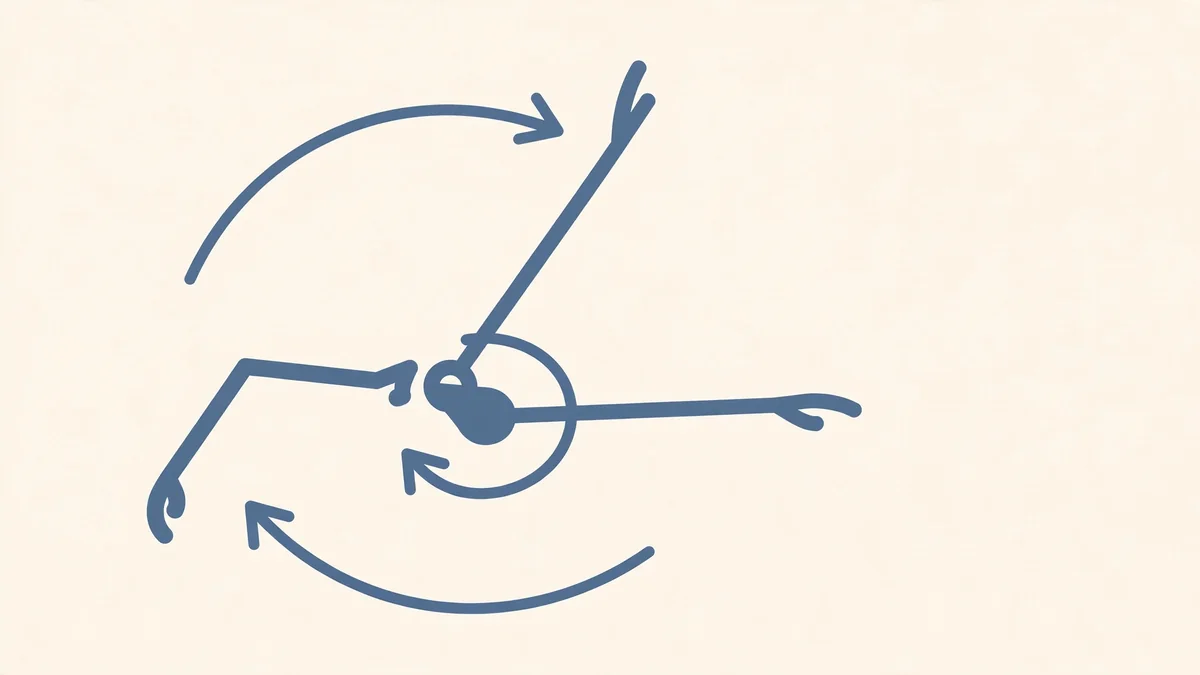
- Around-the-world circles. Sit tall and make one large, slow circle with a relaxed arm in front of you. Keep the movement unhurried. Five circles each side.
- Short, frequent breaks. If you sit for long periods, stand up or do a few seated movements every 30 to 60 minutes. Frequent short movement tends to feel better than one long session.
- Build strength slowly. Add one simple resisted movement two or three days a week, as your energy allows, for example pressing one hand against the other. Progress by resisting a little harder, moving through more range, or doing longer sets. Many clinicians recommend this as part of a long-term plan.
Keep a short log for two weeks. Note what you did and how the shoulder felt the next morning. Patterns are easier to see on paper than in memory.

Where ShoulderBack Pro fits, and where it doesn't
Around the World is the movement here that matches the topic. The site lists the serratus anterior and lower trapezius as its target muscles, and the large, slow circle takes the arm through a good share of its range while one arm guides and the other resists. The Around the World lesson shows it seated or standing.
It won't help frozen shoulder, arthritis or any diagnosed problem, and it's a wellness tool with no clinical trials behind it. If you've been cleared for gentle movement, you can order one online for $29 CAD.
When to see a professional
See a doctor or physiotherapist promptly if you have: pain after a fall or injury with sudden weakness or loss of movement; a shoulder that looks deformed, very swollen or bruised; fever or feeling unwell alongside the pain; chest pain or breathlessness (call emergency services); constant pain that doesn't change with rest or activity; pain that wakes you most nights; numbness, tingling or weakness into the arm or hand; pain in several joints at once; or pain that hasn't improved after a couple of weeks of sensible self-care.
Stiffness that is getting steadily worse, or any loss of movement you cannot explain, should be assessed by a doctor or physiotherapist. They are the people who diagnose whether this is ordinary stiffness, frozen shoulder or something else. Do not start a new routine until you have that assessment if you have had a recent injury, surgery or night pain.
Try this movement
Around the World (serratus anterior, lower trapezius) →Frequently asked questions
Is stiffness with age normal?
Some loss of easy movement is common with age, but it is not inevitable. Many people keep good range with regular movement and strength work. Stiffness that is painful or getting worse deserves a check-up.
What is the difference between stiffness and frozen shoulder?
Stiffness usually comes and goes with movement and activity. Frozen shoulder is a condition where scar-like tissue builds up in the joint and both active and passive movement are lost. A clinician can tell them apart.
Will stiffness go away on its own?
Ordinary stiffness often eases with movement. For frozen shoulder, the evidence does not support waiting it out. Untreated cases improved only partly over one to four years in one review.
Is stretching enough?
Stretching can help some people feel looser in the short term. It works best combined with strength and controlled movement, and it does not replace them.
Can I start if I have not exercised in years?
Usually, yes, with gentle, seated movement and a slow build. Ask your clinician first if you have pain at night, a recent injury or a medical condition.
Sources
- BMC Musculoskeletal Disorders (2026). Exercise interventions for rotator cuff-related shoulder pain in middle-aged and older adults: systematic review and meta-analysis. https://link.springer.com/10.1186/s12891-026-10035-4
- Le HV, Lee SJ, Nazarian A, Rodriguez EK (2017). Adhesive capsulitis of the shoulder: review of pathophysiology and current clinical treatments. Shoulder & Elbow 9(2):75-84. https://pubmed.ncbi.nlm.nih.gov/28405218/
- Wong CK et al. (2017). Natural history of frozen shoulder: fact or fiction? A systematic review. Physiotherapy 103(1):40-47. https://pubmed.ncbi.nlm.nih.gov/27641499/
- PMC narrative review (2026). Body composition, strength, mobility and posture associated with shoulder pain and disability in community-dwelling older adults. https://www.ncbi.nlm.nih.gov/pmc/articles/PMC13513864/