Science explainers & myth-busting
Why Both Sides of the Body Learn From Each Other (Cross-Education)
6-minute read · Published December 9, 2025 · Updated December 9, 2025
What cross-education means
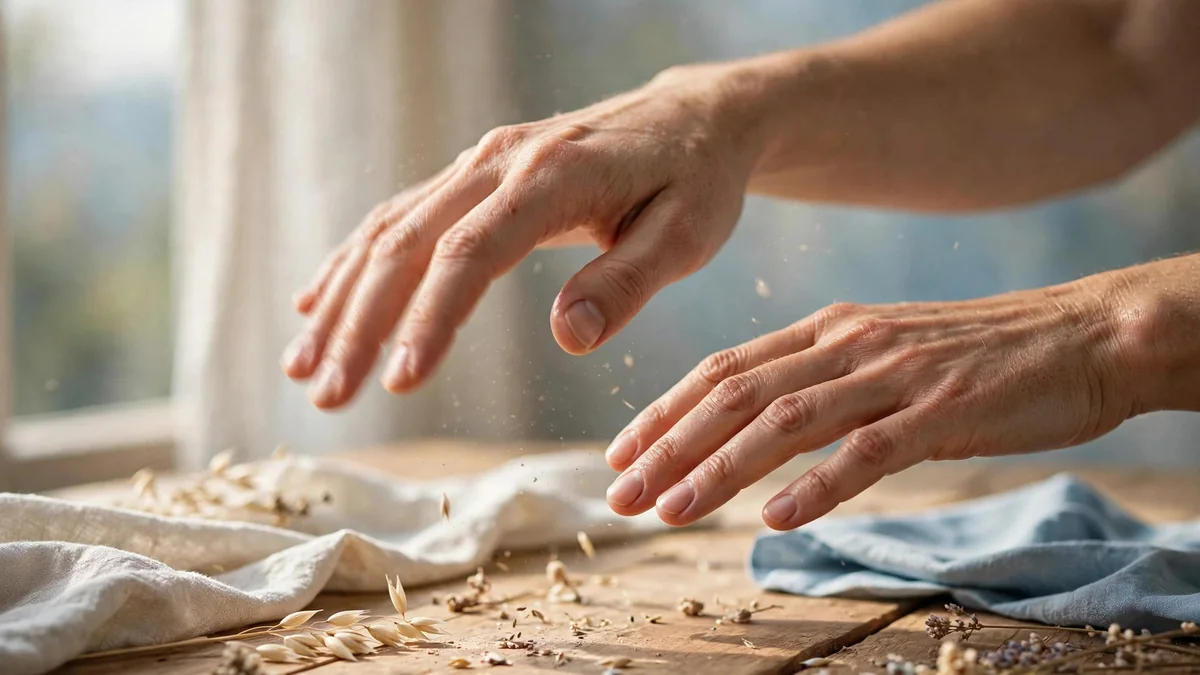
Your brain controls both arms, and it can share what it learns between them. When you practise a movement with one arm, the brain may build a pattern that partly carries over to the other side. This is sometimes called cross-education or interlimb transfer.
Think of it as a teamwork effect. The two sides of the body learn from each other, and that can be useful when one side is sore, limited or recovering. It is not a shortcut, and the size of the effect varies.
Why proprioception matters
Proprioception is your sense of where a joint is in space, without looking at it. Shoulder disorders are linked with reduced joint position sense, and that sense affects how accurately the shoulder moves [R16]. Good proprioception helps you reach, lift and catch without thinking about it.
Proprioception is thought to dull with age and inactivity, and rehab programs commonly work on it after range and strength are restored [R16].
What the research says
- In a 2021 study, training that challenged joint position sense improved proprioception and motor control in the trained wrist. The untrained, opposite wrist improved too, 24 hours later [R15]. This is a wrist study, so it does not prove the same effect in the shoulder.
- In stroke rehabilitation, bilateral training, meaning both arms moving together, produced more shoulder-movement improvement than single-arm training. The authors describe this as interlimb coupling [R14]. This is evidence from stroke patients, not healthy adults.
- Resisted exercise that progresses over time probably helps shoulder-related pain. Gentle movement with no load on its own probably does not [R01].
These findings suggest that two-arm training is worth exploring. They do not prove that any product, including ShoulderBack Pro, improves a shoulder.
What you can do
- Start with one-arm practice (seated). Sit tall and lift one arm slowly forward, then return it. Do 5 to 10 reps, then switch sides.
- Add two-arm mirror movement (seated or standing). Hold both arms out in front of you at the same height. Lift and lower them together, slowly, 8 times.
- Practise position sense. With eyes open, lift the arm to a comfortable height and hold it. Close your eyes for 5 seconds, then open them to check. Keep it gentle.
- Build the load slowly. Once a clinician agrees, add light weight or a light band two or three times a week. Progress only when the last set felt controlled [R01].
- Stop at pain, sharp or sudden. Pain that gets worse during the movement is a reason to pause and ask for advice.
Where ShoulderBack Pro fits, and where it doesn't
ShoulderBack Pro is built around the two-arm idea: one arm guides while the other resists, so the effort is yours to set, and you progress by resisting harder, moving through more range or doing longer sets. SeeSaw is the simplest way to try it, a bilateral glide where one arm guides the other (SeeSaw routine). Arm Wrestler adds a pivot of both forearms inward, with the elbows as hinges. It's a simple movement tool, not a treatment; nobody has run a clinical trial on it; the research above is about other training methods. At $29 with a 30-day guarantee, the trainer is a low-risk way to test the idea.
When to see a professional
See a doctor or physiotherapist promptly if you have: pain after a fall or injury with sudden weakness or loss of movement; a shoulder that looks deformed, very swollen or bruised; fever or feeling unwell alongside the pain; chest pain or breathlessness (call emergency services); constant pain that doesn't change with rest or activity; pain that wakes you most nights; numbness, tingling or weakness into the arm or hand; pain in several joints at once; or pain that hasn't improved after a couple of weeks of sensible self-care [R30].
Only a doctor, physiotherapist or other licensed clinician can diagnose the cause of shoulder pain. If you have had a stroke, a fracture or surgery, follow your clinician's plan first.
Try this movement
SeeSaw (bilateral glide) →Frequently asked questions
What is cross-education in simple terms?
It means training one side of the body can help the other side learn too. Research has found this in the wrist, and some stroke studies show it with arm movement.
Does cross-education mean I can train only one arm?
It may help the other arm, but it does not replace training both sides. If you have a shoulder problem, ask a clinician which side to train and how much.
Does two-arm training beat one-arm training?
Some stroke rehabilitation research found more shoulder-movement improvement with both arms together than with one arm alone [R14]. That is not proof for healthy adults or for any particular product.
Is this proven to help my shoulder pain?
No. Cross-education is an interesting mechanism, not proof of a treatment. Resisted exercise that progresses over time probably helps shoulder pain more than gentle movement alone [R01].
Sources
- Naunton J et al. (2020). Effectiveness of progressive and resisted and non-progressive or non-resisted exercise in rotator cuff related shoulder pain: systematic review and meta-analysis of RCTs. Clinical Rehabilitation. https://search.pedro.org.au/search-results/record-detail/61404
- Journal of Physical Therapy Science (2016). The effects of bilateral movement training on upper limb function in chronic stroke patients. https://pmc.ncbi.nlm.nih.gov/articles/PMC5011582
- Scientific Reports (2021). Proprioceptive-focused training transfers gains to the opposite, untrained limb. https://pmc.ncbi.nlm.nih.gov/articles/PMC7935923
- Mureşan et al. (2022). Effects of a novel proprioceptive rehabilitation device on shoulder joint position sense, pain and function. Medicina. https://www.ncbi.nlm.nih.gov/pmc/articles/PMC9505091/
- NHS Greater Glasgow & Clyde, Shoulder red flags; NHS MPFT, Self-help: shoulder pain; BESS/BOA shoulder pathway summary (2021). https://www.nhsggc.scot/page_category/services/page/33