Science explainers & myth-busting
The Shoulder 'Impingement' Debate: Why Surgeons Changed Their Minds
6-minute read · Published February 11, 2026 · Updated February 11, 2026
What the word "impingement" describes
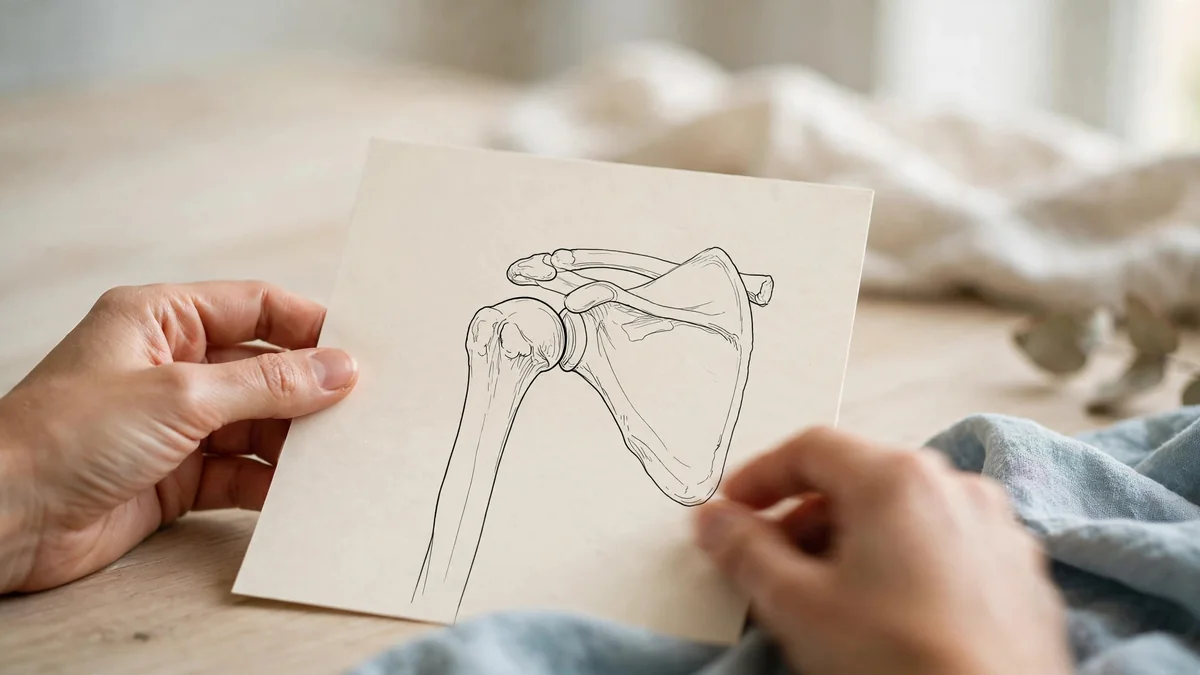
The top of your shoulder blade (the scapula) forms a bony roof over the ball of the upper arm. Between that roof and the ball sits a narrow space called the subacromial space. The rotator cuff tendons pass through it, along with a small fluid-filled cushion called the bursa. The rotator cuff is a group of four small muscles that steady the shoulder joint.
The original idea was simple. When you lift the arm, the tendons and bursa get squeezed in that space, and the squeeze causes pain. The word "impingement" comes from that picture of pinching.
The picture is useful, but it does not explain every case. Some people with the pinching pattern have no pain. Some people with pain do not seem to have a pinch at all. That gap is a big part of why the label has been rethought.
Why the label got a rethink
Many clinicians now describe shoulder pain as rotator cuff-related shoulder pain. This is an umbrella term. A 2025 review uses it to cover subacromial pain (the pain around that space), tendinopathy (irritated, overloaded tendon) and symptomatic tears [R03].
The umbrella term matters because it says the pain can come from more than one place. It also points the treatment conversation toward the whole shoulder, including the shoulder blade and the control of the arm, instead of one pinch.
This piece cannot say exactly what surgeons decided or why. It can explain the term and what the research says about exercise. The surgical question deserves a direct conversation with a clinician who has examined your shoulder.
What the research says
- A 2025 systematic review found that mobilization and stretching improved function and pain over about two months. It also found that scapular stabilization exercise (training the muscles around the shoulder blade) improved pain and function [R03].
- A 2026 systematic review found that exercise reduces pain and improves function and range of motion in middle-aged and older adults with rotator cuff-related shoulder pain [R04].
- Exercise that adds resistance and progresses over time probably helps this kind of pain. Gentle unloaded movement alone probably does not move the needle on pain [R01].
- Programs that teach control and coordination may reduce disability slightly more than generic exercise, with moderate certainty in the evidence. We do not fully know why [R02].
- Most shoulder pain is managed in primary care with advice and exercise. Some health services now advise against routine ultrasound or MRI unless the result would change the treatment plan [R30].
The pattern across these sources is consistent: exercise is a strong first-line option for this kind of pain. The sources do not tell us how exercise compares with surgery for any one person.
What you can do
- Write down which movements hurt: reaching overhead, lifting from a chair, reaching behind your back. Clear patterns help a clinician decide what to test.
- Ask for a proper assessment before you choose a path. Surgery and injections are decisions for a clinician who has examined your shoulder, not for a label on a form.
- Try gentle, controlled movement you can do seated. Slide your forearm along a table, or do a small shoulder blade squeeze and release with your arms resting at your sides.
- Build resistance slowly, as the research suggests. Progress only with guidance, and only when the movement feels controlled.
- Keep moving within comfort instead of resting completely. Many clinicians advise continuing gentle activity unless a movement causes sharp pain.
Where ShoulderBack Pro fits, and where it doesn't
ShoulderBack Pro does not fit this topic. It cannot tell surgical cases from non-surgical ones, so a physiotherapist or orthopaedic clinician is the right person to ask. General movement ideas live on the routines page, for later.
When to see a professional
See a doctor or physiotherapist promptly if you have: pain after a fall or injury with sudden weakness or loss of movement; a shoulder that looks deformed, very swollen or bruised; fever or feeling unwell alongside the pain; chest pain or breathlessness (call emergency services); constant pain that doesn't change with rest or activity; pain that wakes you most nights; numbness, tingling or weakness into the arm or hand; pain in several joints at once; or pain that hasn't improved after a couple of weeks of sensible self-care.
A doctor or physiotherapist is the person who can diagnose which problem is behind your shoulder pain. This article cannot do that.
Try this movement
SeeSaw (bilateral glide) →Frequently asked questions
Is impingement a real diagnosis?
Many clinicians now use broader terms, such as rotator cuff-related shoulder pain. Ask yours which term applies to you and why.
Do I need surgery for impingement?
Not everyone does. The sources reviewed for this article do not settle the surgical question, so the decision belongs with a clinician who has examined your shoulder.
Should I rest until the pain stops?
Full rest is often not the answer. Progressive, resisted exercise probably helps this kind of pain, while unloaded movement alone probably does not move the needle on pain. Pain that wakes you at night needs a check.
Is it safe to keep exercising?
Many clinicians advise continuing gentle exercise within comfort. If your pain is new, severe or getting worse, check with your clinician first.
Sources
- Dubé M-O et al. (2024). The Efficacy of Exercise Therapy for Rotator Cuff-Related Shoulder Pain According to the FITT Principle: Systematic Review With Meta-analyses. JOSPT. https://pubmed.ncbi.nlm.nih.gov/38848304/
- Frontiers in Bioengineering & Biotechnology (2025). Specific modes of exercise to improve rotator cuff-related shoulder pain: systematic review and meta-analysis. PROSPERO CRD42024550602. https://pmc.ncbi.nlm.nih.gov/articles/PMC12011739/
- Naunton J et al. (2020). Effectiveness of progressive and resisted and non-progressive or non-resisted exercise in rotator cuff related shoulder pain: systematic review and meta-analysis of RCTs. Clinical Rehabilitation. https://search.pedro.org.au/search-results/record-detail/61404
- BMC Musculoskeletal Disorders (2026). Exercise interventions for rotator cuff-related shoulder pain in middle-aged and older adults: systematic review and meta-analysis. https://link.springer.com/10.1186/s12891-026-10035-4
- NHS Greater Glasgow & Clyde, Shoulder red flags; NHS MPFT self-help, Shoulder pain; BESS/BOA pathway summary (2021). https://www.nhsggc.scot/page_category/services/page/33