Canadian seasons, caregivers & community
Fall Leaves and Ladder Safety: Shoulders, Balance and Reach
4-minute read · Published October 2, 2026 · Updated October 2, 2026
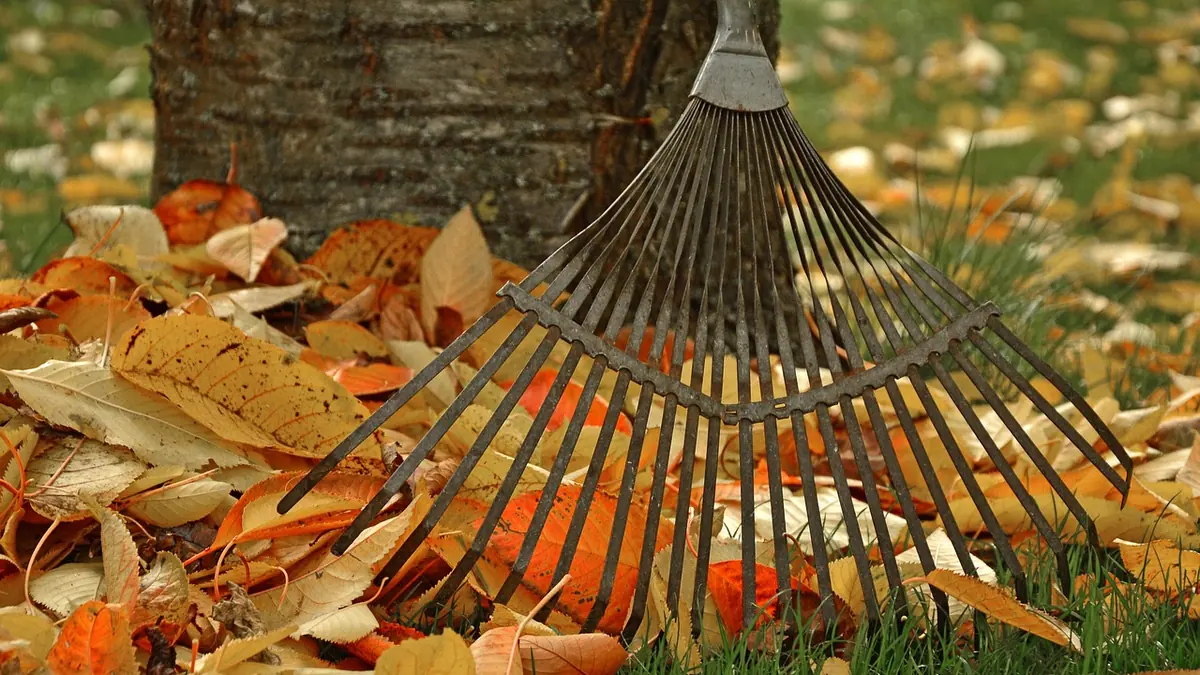
Raking, bagging and reaching up to clear the eaves all ask a lot of your arms. Here is how to prepare, and when to stop.
Why this happens
Leaves are light, but raking means repeated reaching and pulling with the arms held out in front. If your shoulders have been still all summer, they may tire sooner. Soreness after a long session can mean the load was more than they were ready for.
Strength, mobility and posture are linked to shoulder pain in adults 60 and over [R28]. That is an association, not proof of cause.
What the research says
- Strength training supports older adults. A position statement on resistance training says it supports strength, function, mobility and independence in older adults [R06].
- Balance and strength matter for older adults. The WHO recommends that adults 65 and over do activity that builds balance and strength on at least three days a week [R07].
What you can do
- Warm up before the big job. Sit tall and do slow shoulder circles and gentle reaches for a few minutes. Stand only if you feel steady.
- Work in short blocks. Rake for a while, then rest. Switch sides so one shoulder does not carry all the work.
- Keep the work close to your body. Reaching far out from the body puts more load on the shoulder. Step closer instead.
- Set up a ladder safely, or skip it. Use a sturdy ladder on firm, level ground. Have someone steady it. Do not lean sideways. If you are unsure, hire help.
Where ShoulderBack Pro fits — and where it doesn't
For a warm-up before raking, SeeSaw and Crosscuts are the two that match best. SeeSaw has one arm guide the other through slow reaches, and Crosscuts is a diagonal glide from high shoulder to opposite hip, close to the raking motion. Both can be done seated. The printable fridge card keeps the routine where you will see it, and you can see ShoulderBack Pro if a seated trainer suits you.
It is a wellness tool, not a treatment, and it does nothing for balance, ladder safety or fall risk. After a fall or sudden pain, see a clinician before any new routine.
When to see a professional
See a doctor or physiotherapist promptly if you have: pain after a fall or injury with sudden weakness or loss of movement; a shoulder that looks deformed, very swollen or bruised; fever or feeling unwell alongside the pain; chest pain or breathlessness (call emergency services); constant pain that doesn't change with rest or activity; pain that wakes you most nights; numbness, tingling or weakness into the arm or hand; pain in several joints at once; or pain that hasn't improved after a couple of weeks of sensible self-care.
A fall or sudden shoulder injury needs assessment first. Most shoulder pain is managed with advice and exercise [R30], but not after a fall.
Try this movement
Printable fridge card →Frequently asked questions
Should I stretch my shoulders before raking?
Gentle, slow movement is a reasonable start. Avoid bouncing into stretches or pushing into pain.
Is it safe to climb a ladder with sore shoulders?
If your shoulders hurt, let someone else handle the ladder.
Can strength work help older adults reach and lift more comfortably?
Resistance training supports strength, function and independence in older adults [R06]. New, sudden or severe pain needs a clinician first.
Sources
- Fragala MS, Cadore EL, Dorgo S et al. (2019). Resistance Training for Older Adults: Position Statement From the National Strength and Conditioning Association. J Strength Cond Res. https://pubmed.ncbi.nlm.nih.gov/31343601/
- WHO (2020). Guidelines on physical activity and sedentary behaviour. University of Sydney summary. https://www.sydney.edu.au/news-opinion/news/2020/11/26/new-global-guidelines-on-physical-activity-and-sedentary-behavio.html
- PMC narrative review (2026). Body composition, strength, mobility and posture associated with shoulder pain and disability in community-dwelling older adults. https://www.ncbi.nlm.nih.gov/pmc/articles/PMC13513864/
- NHS Greater Glasgow & Clyde — Shoulder red flags; NHS MPFT self-help — Shoulder pain; BESS/BOA pathway summary (2021). https://pmc.ncbi.nlm.nih.gov/articles/PMC7905504