Posture, shoulder blades & desk life
Rounded Shoulders: What Exercise Can and Cannot Do (An Honest Guide)
10-minute read · Published June 15, 2026 · Updated June 15, 2026

If someone has told you that your shoulders are rounded, you may have felt a little judged. You may also have a clear question: can I fix this? This guide gives a plain, evidence-based answer. It is the main page in our posture cluster. For the shoulder pain side of things, see our guide to when to see a doctor.
Rounded shoulders are not a moral failing, and they are not a diagnosis. They are a description of how the shoulders sit. The goal of this guide is to help you decide what is worth trying, what is not, and when to get help.
What "rounded shoulders" means
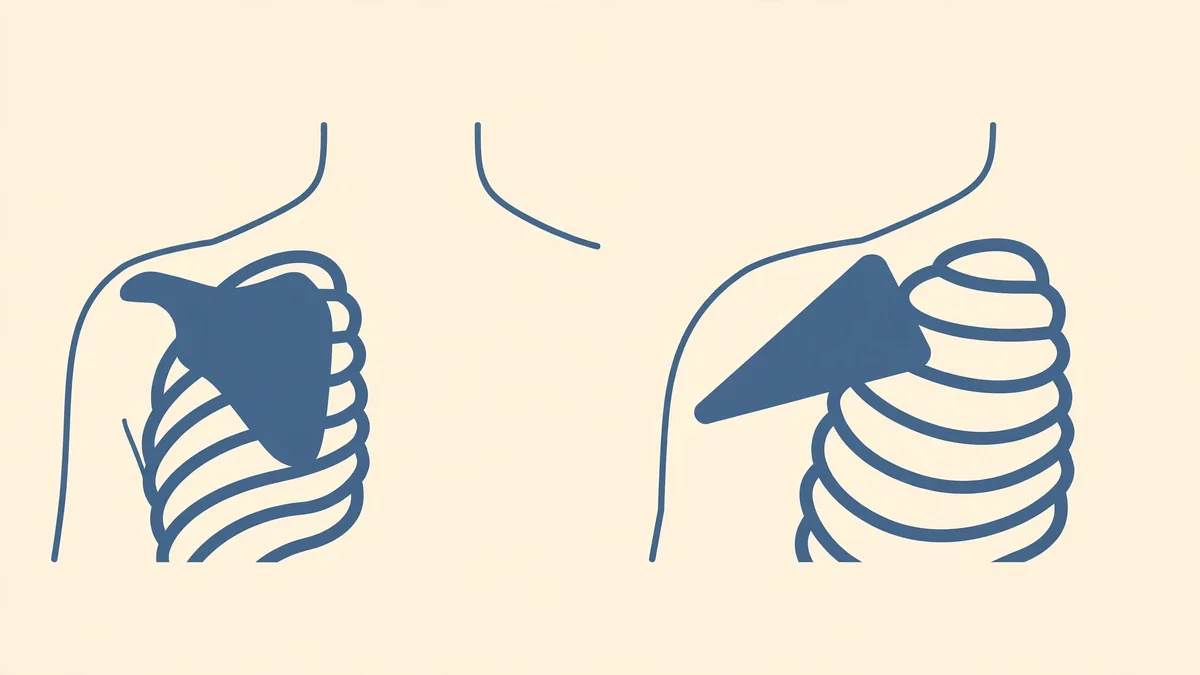
Rounded shoulders describe shoulders that roll forward. The upper back may look more curved, and the head may sit a little forward. Your shoulder blade (scapula) is a flat, triangle-shaped bone. It sits on the back of your rib cage, held in place by muscles.
Your shoulder blade needs to move well. It slides, tilts and rotates as your arm moves. When the muscles that hold it are weak or do not coordinate well, the whole shoulder can feel unsettled. That is one reason people link posture with comfort.
The word "rounded" is a description, not a verdict. Many people with rounded shoulders have no pain at all. Many people with upright posture have pain. Shape alone does not tell the story.
Does posture cause pain?
This is the question most people really want answered. The honest answer is that the research is not settled.
An umbrella review of 41 systematic reviews found no consensus that spinal posture causes low back pain [R25]. That review was about the lower back, but it shows how hard posture is to pin down as a cause.
Neck pain shows a similar pattern. Forward head posture is associated with neck pain, and exercise-based programs are the main treatment studied for it [R27]. The word to notice is "associated." Association is not the same as cause.
In older adults, strength, mobility, body composition and posture are each linked to shoulder pain and disability. These are changeable targets, which is encouraging. But the research does not prove that any one of them is the cause [R28].
So posture may be one piece of a larger picture. Your muscles, your daily load, your sleep, your activity and your pain sensitivity may all matter too.
What the research says about exercise
Exercise is the most studied option for shoulder pain. The details matter.
- Exercise that adds resistance and progresses over time probably helps rotator cuff-related pain. Gentle, unloaded movement alone probably does not move pain much [R01].
- Programs that teach control and coordination may edge out generic exercise in the short and medium term, though we do not fully know why [R02].
- Exercise can improve forward head angle. The link between that change and a change in pain is still unsettled [R26].
Put plainly: strength and control work probably beats gentle movement alone for pain. But it is not a guaranteed route to better posture or no pain.
Why exercise helps some people
Exercise can change more than your muscles. Many people report feeling stronger, more confident, and less tight after a steady routine. Some find they can sit longer or reach higher with less discomfort.
Responses vary. One person's shoulder may settle quickly and another's may take months, and neither means the person did it wrong.
Think of exercise as a way to build capacity. You are teaching your shoulder blade and upper back to work together, and building strength you can use in daily life. You are not trying to reset your skeleton.
Common questions about posture and pain
Is there a "correct" posture? Most people do best with a posture they can change. Holding one position for hours, even a good-looking one, can feel uncomfortable. Many clinicians suggest moving often rather than chasing a perfect shape.
Does rounding mean something is wrong with my spine? Not necessarily. Rounded shoulders are a common way to sit and stand. A clinician can examine your shoulders and neck to see whether anything needs attention.
Why do I feel better sitting tall, then worse later? Holding any single position for a long time can tire the muscles that support it. Changing position often, and building strength, may help you stay comfortable across the day. This is a reasonable explanation, not a proven one.
Should I worry about the shape of my shoulders? Shape alone is not a reason for alarm. If one shoulder blade sticks out, or you notice weakness or pain that spreads into the arm, get it checked. Our guide to winged shoulder blades explains the signs.
What you can do
- Notice your day. Track when your shoulders feel tight, and what you were doing. Seated option: do this from your chair, with a notebook beside you.
- Build upper-back strength. Try a light band or light weights for rows, two or three times a week. Progress by pulling harder, moving through more range or doing longer sets. Seated option: sit tall and anchor a band around a sturdy chair leg, then pull gently.
- Practise shoulder-blade control. Gently draw your shoulder blades back and down, then release. Hold for a few easy breaths. Seated option: this works best sitting tall.
- Keep moving through range. Reach overhead slowly and comfortably, then return. Seated option: sit with your back supported and reach at your own pace.
- Break up long sitting. Stand up and move every so often, even briefly. Seated option: small reaches and shoulder rolls count.
- Progress when movement feels controlled. If you can move smoothly from start to finish, you can consider a little more effort. Seated option: increase range before effort.
- Stop if pain rises. Mild effort is fine. Sharp pain, or pain that lingers the next day, means you should back off and get advice.

Where ShoulderBack Pro fits — and where it doesn't
The one part of this picture ShoulderBack Pro touches is upper-back control. Bear Hugs Me is designed to work the middle trapezius and rhomboids: you draw the trainer toward your chest while the other arm resists, so you set the effort, and you can do it seated. Progress by resisting harder or breathing through a wider range.
It does not address desk setup, neck pain, nerve symptoms or the cause of your pain. It is not a posture corrector, and it has no clinical trials. If you are curious, the trainer is here.
When to see a professional
See a doctor or physiotherapist promptly if you have: pain after a fall or injury with sudden weakness or loss of movement; a shoulder that looks deformed, very swollen or bruised; fever or feeling unwell alongside the pain; chest pain or breathlessness (call emergency services); constant pain that doesn't change with rest or activity; pain that wakes you most nights; numbness, tingling or weakness into the arm or hand; pain in several joints at once; or pain that hasn't improved after a couple of weeks of sensible self-care.
A doctor or physiotherapist is the right person to assess shoulder pain and decide whether posture plays a role. If you have had surgery or a recent injury, follow your surgeon's or physiotherapist's plan first.
Try this movement
Bear Hugs Me (middle trapezius, rhomboids) →Frequently asked questions
Can exercise fix rounded shoulders?
Exercise may improve strength, control and comfort for some people. It cannot promise to change the shape of your shoulders, and results vary from person to person.
Are posture correctors worth it?
We do not have strong research on posture devices in our sources. Many clinicians suggest focusing on movement and strength rather than relying on a device.
How long before I notice a difference?
Results vary. Many people need consistent practice over time before they notice a change in strength or comfort. Track how you feel, not only how you look.
Should I stretch my chest?
Some people find gentle chest stretches comfortable. Stop if a stretch causes sharp pain, and ask a clinician if you are not sure what is right for you.
When is it more than posture?
Get checked if shoulder or arm pain comes with numbness, tingling, weakness, or pain after an injury. Those signs need a clinician, not a posture plan.
Sources
- Swain CTV et al. (2020). No consensus on causality of spine postures or physical exposure and low back pain: umbrella review of 41 systematic reviews. J Biomechanics (secondary summary). https://getfitcraft.com/guides/exercises-for-posture
- Sheikhhoseini R et al. (2018). Effectiveness of therapeutic exercise on forward head posture: systematic review and meta-analysis. J Manipulative Physiol Ther (secondary summary). https://getfitcraft.com/guides/exercises-for-posture
- Healthcare (MDPI) 2023; 11(19):2604. Treatment of chronic neck pain in patients with forward head posture: systematic narrative review. https://www.mdpi.com/2227-9032/11/19/2604
- PMC narrative review (2026). Body composition, strength, mobility and posture associated with shoulder pain and disability in community-dwelling older adults. https://www.ncbi.nlm.nih.gov/pmc/articles/PMC13513864/
- Naunton J et al. (2020). Effectiveness of progressive and resisted and non-progressive or non-resisted exercise in rotator cuff related shoulder pain: systematic review and meta-analysis of RCTs. Clinical Rehabilitation. https://search.pedro.org.au/search-results/record-detail/61404
- Dubé M-O et al. (2024). The Efficacy of Exercise Therapy for Rotator Cuff-Related Shoulder Pain According to the FITT Principle: Systematic Review With Meta-analyses. JOSPT. https://pubmed.ncbi.nlm.nih.gov/38848304/